Cortez planning board to weigh faster historic designations
The Planning and Zoning Commission holds two public hearings Tuesday — one on letting council designate historic properties by resolution instead of ordinance, one on letting commissioners attend by video. It is the first P&Z agenda the city has posted on its public portal this fall.
The Cortez Planning and Zoning Commission meets Tuesday at 6:30 p.m. with two public hearings on its agenda, both of them recommendations to City Council about how the city runs its own processes rather than decisions on any particular property.
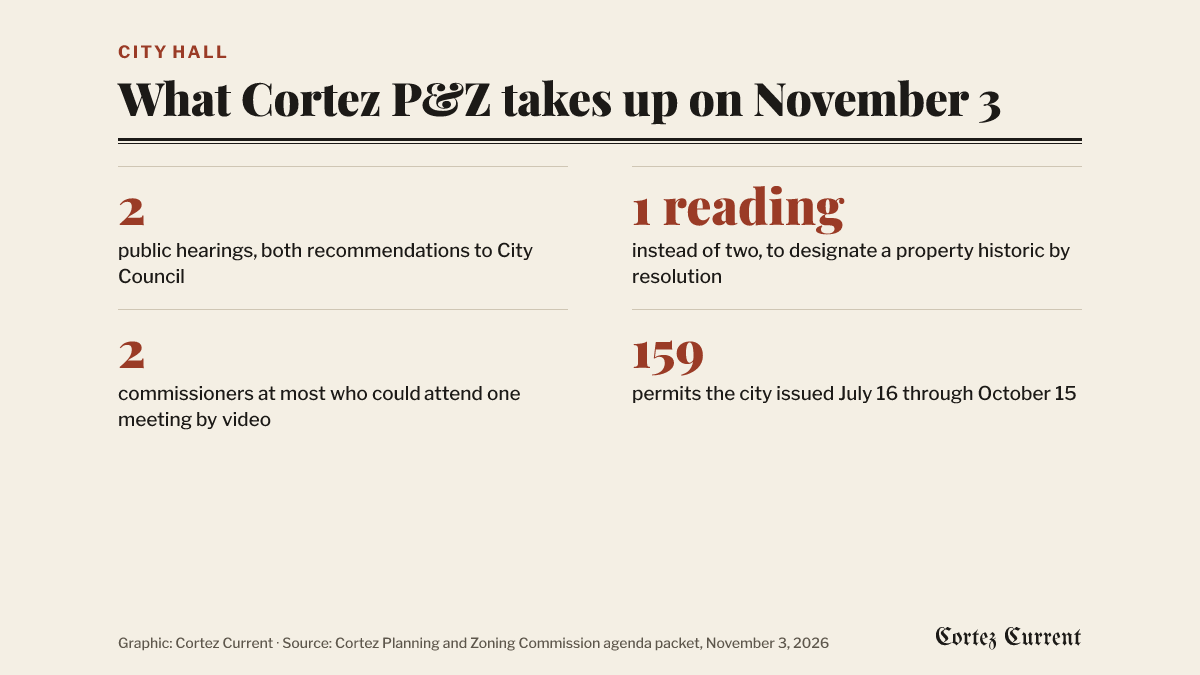 Graphic: Cortez Current. Source: Cortez Planning and Zoning Commission agenda packet, November 3, 2026
The first would shorten the path to designating a building historic. Under the Land Use Code the city adopted in March 2025, council has to pass an ordinance to confer historic designation, which means two readings at two separate meetings. Council asked at its October 13 regular meeting for that to change to a resolution, which takes one reading. The public hearing stays either way.
What the code change does
Deputy Community and Economic Development Director Jason Armstrong, the city planner presenting both items, sets out three edits to the Land Use Code in his memo to the commission:
- Table 6.1, in Section 6.01. The historic designation row’s City Council column now reads “
(two readings, no hearing at first reading).” It would become simply “ ” — keeping the public hearing and dropping the two-reading requirement. - Section 7.02.7, item 3. The historic preservation board now recommends that council “designate by ordinance” a qualifying property. That becomes “designate by resolution.”
- Section 7.03.3.A. Council holds a public hearing “to consider adopting by ordinance” qualifying properties within 30 days of the board’s recommendation. That becomes “by resolution.” The 30-day deadline and the notice requirements in Section 6.02.5 are unchanged.
The commission’s job Tuesday is to hold the hearing and decide whether to recommend the changes to council as Resolution No. 9, Series 2026. Staff’s memo also offers the commission an alternate motion: direct staff to make further revisions and continue the hearing to the December 1 meeting.
The second hearing: commissioners by video
Resolution No. 7, Series 2026 would ask council to amend the City Code so commissioners can take part in meetings by videoconference. The resolution does not change the code itself; it starts the process by which council would.
The commission looked at a draft at its August 4 meeting and, Armstrong’s memo says, agreed the option was appropriate because it would give the needed flexibility to hold quorums and keep members. The draft was modeled on the electronic participation policy council adopted for itself on September 23, 2025, then adapted. Because the Land Use Code is largely silent on the commission and defers to Article II of the City Code for meeting protocol, the changes would go into Chapter 2 of the City Code, in Sections 2-6, 2-8 and 2-9.
The version going to the hearing carries limits the commissioners themselves asked for:
- No more than two members may take part electronically at any one meeting.
- A member may do so at no more than three meetings per calendar year.
- Both limits are waived for a meeting the commission decides cannot practically be held in person because of an emergency, such as a public health crisis, severe weather or a natural disaster.
- The chair may not participate electronically, except at a meeting called to approve a fully electronic meeting and at one.
- A member must give written notice to the Zoning Administrator by city email at least two business days ahead; if more than two ask, the first two to give notice get the slots.
- Electronic participation counts as attendance for quorum and for casting votes, and a member taking part that way is not charged with an absence under the rule that vacates a seat after three consecutive unexcused absences.
- The chair may cut off a member’s electronic participation if the connection keeps dropping, the quality is very poor or there is disruptive background noise.
- Members may take part electronically in quasi-judicial matters such as variance, conditional use and zoning hearings, confirming by doing so that they have reviewed the submitted materials, and in executive sessions, confirming that no third party can see or hear them.
Also on the agenda
The commission is set to approve the minutes of its September 1 meeting and to review a report of the permits the city issued between July 16 and October 15 — 159 in all, including 10 accessory structures, two commercial remodels, 17 public right-of-way permits and seven signs.
Public participation comes before the hearings, and the agenda says speakers may not use that period to comment on items that are on the agenda. There is no cap on the number of speakers but the period is held to 30 minutes overall, with three minutes each, one turn per person and no ceding time to someone else.
The meeting is chaired by Robert Rime. The city streams its Planning and Zoning meetings on the council meetings channel, where a placeholder for Tuesday’s meeting went up on October 28. The agenda and packet are on the city’s public portal. The meeting is at City Hall, 123 Roger Smith Avenue.