Mancos flood topped the 1937 record, after-action report says
A draft report in the trustees' Nov. 11 packet says the Mancos River crested several feet above the town's 1937 benchmark and that nobody was killed. Trustees will also ratify a disaster declaration and read written criticism of the town's own communication.
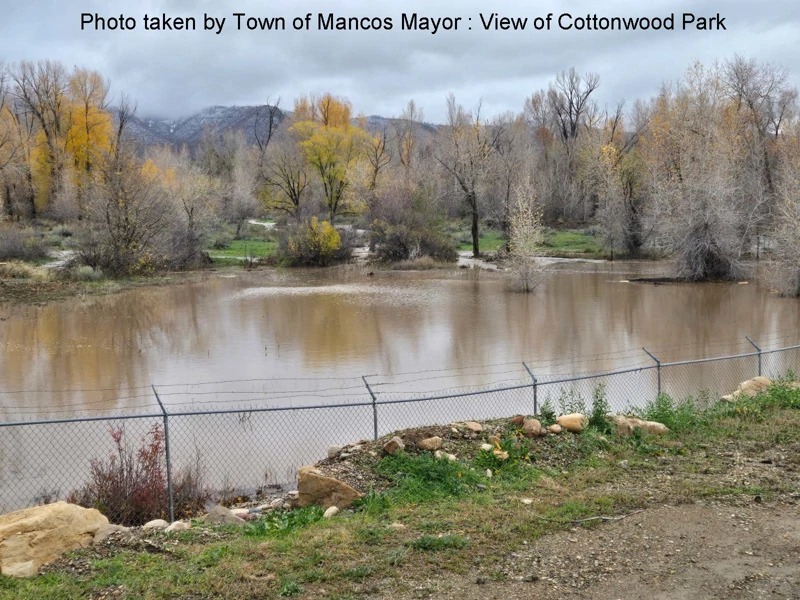
The Mancos River flood that drove people from their homes on Nov. 1 ran several feet higher than the town’s worst flood on record, according to a draft after-action report the Town of Mancos published this week in the packet for its Nov. 11 board meeting.
“Hydraulic flood levels significantly exceeded the historical benchmark record set during the 1937 Mancos River flood event by several feet,” the report says. It also says that despite what it calls severe resource constraints as the river crested, “zero fatalities or major injuries were reported.”
The 25-page packet, posted on the town’s website on Friday, is the fullest public account the town has given of the flood and its response. It also sets up two decisions and one long discussion for the Board of Trustees on Wednesday.
Ratifying the disaster declaration
Mayor Cindy Simpson declared a local emergency on Monday, Nov. 1. Under state law a mayor’s declaration lapses after seven days unless the governing board consents, so trustees will vote on Resolution 12, Series 2026, which formally declares a local disaster emergency over what the town calls the Mancos River Flood Event.
Town Administrator Heather Alvarez writes in her staff report that the town has also sent a letter to its congressional representatives asking President Trump to declare an emergency. Gov. Jared Polis declared an emergency for southwest Colorado on Oct. 22. Town staff are keeping records on standard FEMA forms “in the event funding becomes available to assist with mitigation efforts,” the report says.
What the report says happened
The report puts the flood’s start at about 5 p.m. on Nov. 1 and says active emergency response gave way to short-term recovery the next day. It traces the water to a Pacific atmospheric river carrying concentrated moisture over the San Juan Mountains and into the Mancos River basin, falling on ground already soaked by three days of rain.
It lists severe damage at both the wastewater treatment facility and the water treatment plant, roads under water, bridges overtopped and private property damaged where the riverbank gave way. Those are the same failures behind the water problems the town is still working through: a boil-water advisory the state required on Friday, a closed water dock and a warning this week that the town could run short of treated water.
On the scene, the report counts five Mancos Marshal’s Office personnel, three from public works, two water and wastewater operators, a public information officer, a trustee liaison, a Mesa Verde National Park ranger, a Colorado Parks and Wildlife ranger, and 11 personnel from the Mancos and Cortez fire protection districts. It names Chief Marshal Justen Goodall as the point of contact.
The report credits mutual aid with letting outside agencies take over traffic control and medical response so town officers could concentrate on life safety, and credits a multi-agency unified command, real-time mapping across three counties, wireless emergency alerts and reverse-911 calls, satellite internet and radio repeaters that stayed up, and a Red Cross shelter that opened quickly.
Where it asks for improvement, it points to perimeter control in evacuation zones — specifically property owners who refused to leave — public education about the danger of entering floodwater or gathering on bridges, formal written agreements with shelter buildings, and cross-training a second person to do the public information officer’s job.
Trustees’ own criticism, in the packet
The packet also prints unsigned written feedback from trustees, which is blunter than the report itself.
“There was minimal communication from the Town leading up to and throughout the emergency response,” one passage reads. Another says that before the pre-evacuation alert, residents got no warning that heavy storms or flooding were possible, and that “without presenting facts, rumors spread.” One passage says “MANY people do not have Facebook, so relying on it as our sole method for communication is a disservice to residents,” and asks whether the town could post updates on its own website or use its Everbridge alert system for more than evacuation orders.
Another passage questions why the town set up a sandbag station only after the flood had gone down, and says having filled bags on hand might have prevented a late-night sandbagging effort on East Grand Avenue that marshals broke up. One trustee’s note refers to a warning that was expected to give three to five hours and gave about 40 minutes.
The feedback ends: “While staff worked diligently throughout the emergency, the town’s role in communicating with the public and demonstrating community leadership during the event may not have been as clear or coordinated as it could have been. I believe it is important that we discuss this openly, not to assign blame, but to clarify expectations and develop a more coordinated approach for future emergencies.”
The packet carries two more draft documents alongside the report: a guide to what trustees, staff and the public are each supposed to do in an emergency, modified and adopted Nov. 4, and a set of pre-written emergency broadcast scripts for wildfire, blizzard, flash flood, shelter-in-place, shelter openings and boil-water notices. An improvement plan at the back assigns PIO cross-training to Alvarez and Goodall starting Nov. 1 and ongoing, shelter agreements to town administration and the board starting Nov. 15 with a target of the first quarter of 2027, and perimeter enforcement and public education to the Marshal’s Office starting Dec. 1 with a target of the second quarter of 2027.
The report is labeled two ways. Alvarez’s staff report calls it a draft, says responding agencies have not yet had their say, and says the final version will be emailed to trustees and posted on the town’s website. The document itself is headed “Version 1.0 (Official Executive Final)” and dated Nov. 4. Trustees are being asked to review and discuss it, not to adopt it.
The rest of the meeting
A workshop on the draft 2027 budget starts at 5:30 p.m. The town’s notice says workshops are for board discussion, that no decisions can be made in them, and that they are open to the public but take no public comment. The regular meeting starts at 6 p.m.
The consent agenda carries October bills and claims totaling $122,218.65 and the minutes of the Oct. 28 meeting. Trustees will also hear follow-up reports from the Mancos Common Press and the Mesa Verde Literary Festival, which each received $1,500 in the second round of the town’s agency contributions this year. Alvarez writes that from now on the town will run one round a year, with applications due in October and awards sent in December.
The agenda ends with an executive session on a personnel matter — the town administrator’s evaluation — under C.R.S. 24-6-402(4)(f). The agenda says any action on contract and compensation would be taken in the public meeting.
Nov. 11 is Veterans Day. Alvarez told trustees at the Oct. 28 meeting that the town is holding the meeting anyway.
Looking ahead, the Dec. 9 agenda is set to carry the resolution adopting the 2027 mill levy and budget, a discussion of Chapter 5 of the comprehensive plan, and an ordinance adopting the 2024 Model Traffic Code.
The meeting is at Mancos Town Hall, 117 N. Main St. The board packet is on the town’s website.