Cortez council takes first vote on $39 million 2027 budget
Tuesday's agenda carries a first reading of the city's 2027 budget, a new contract for the municipal judge and a resolution the police department needs to collect its share of a statewide training fund. A regional study that says Cortez needs 1,045 homes goes to council the same night.
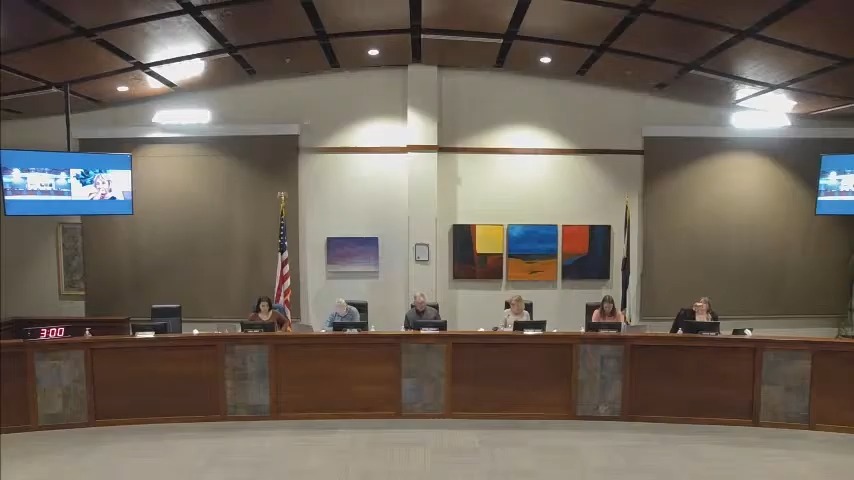
The Cortez City Council takes its first vote on the city’s 2027 budget on Tuesday, in a meeting that also brings a new contract for the municipal judge, a resolution the police department needs in order to collect money from a statewide fund, and a regional study on how many homes Cortez is short.
The regular meeting starts at 7:30 p.m. on Tuesday, Nov. 10, at City Hall, 123 Roger Smith Ave. A work session runs first, at 6 p.m. Both are streamed on the city’s council meetings channel, and the agenda and packet are on the city’s public portal.
The budget: first reading Tuesday, hearing Nov. 24
Ordinance No. 1378, Series 2026, is the city’s 2027 budget, and Tuesday is its first reading. The second reading and the public hearing are set for Nov. 24, which is where the public comment the ordinance invites will be heard.
Finance Director Randy Bailey’s memo in the packet puts total expenditures in the proposed budget at $39 million, with $5.4 million drawn from reserves to pay for planned capital work. The reserve draws are $1.7 million from the General Fund, $700,000 across the Streets Improvement and Equipment funds, $1.4 million from the Recreation Center Fund, $1.1 million from the Water Utility Fund and $400,000 from the Airport Fund.
The capital plan is split roughly in two. About $3.2 million of it sits in the governmental funds, which the memo says goes mainly to replacing police vehicles, rehabilitating facilities, street improvements and refreshing equipment. About $3.3 million sits in the proprietary funds, for water system infrastructure, refuse equipment, rehabilitation of the Recreation Center natatorium and airport operations.
Inside the General Fund, the budget appendix shows 2027 revenue of $14,595,150, plus $1,736,408 from fund reserves and $204,571 in grant proceeds, for total revenue of $16,536,129. Expenditures come to the same figure. That is down from a 2026 final budget of $17,075,654.
The memo says every director and supervisor reviewed the proposed budget through the city’s ClearGov system before it came to council, and that the city manager and the finance director met each director individually. A draft is posted on the city’s website under “DRAFT 2027 Budget.”
A new contract for the municipal judge
Council will consider a 2027 professional services contract with Padilla Law, PC, for municipal judge services, to run from Jan. 1, 2027. The contract engages the firm through Beth Padilla, who sits as the Cortez municipal judge.
The contract sets annual compensation at $70,000, paid monthly at $5,833.33. A memo from the city attorney’s office says the judge’s contract has been amended several times in recent years, and that rather than keep amending it the city is putting a new contract in front of council. The memo says the new contract differs from previous ones in a number of ways, “including an increase in compensation and a severance agreement.” Staff recommends approval.
Judge Padilla is also on the work session agenda earlier in the evening, to give council a municipal court update.
Proposition 130 money for the police department
Resolution No. 18, Series 2026, would commit the city and the Cortez Police Department to spend money from the state’s Peace Officer Training and Support Fund in the way state law requires. The memo says the fund was created by Proposition 130 and Senate Bill 25-310, and is codified at C.R.S. 24-33.5-122.
A memo from Police Chief Vern Knuckles explains what the resolution is for. The Division of Criminal Justice hands the money out by a statewide formula, and each participating agency gets at least $15,000; anything above that is set after the certification deadline. To receive a distribution, the department has to submit officer and budget information through a state portal and upload a council resolution committing to spend the money under the statute.
The money can go to peace officer education and training and to compensation — pay for new, current or rehired officers, academy tuition reimbursement, and hiring, rehiring, merit or retention bonuses — and it has to be spent on top of what the city already spends on those things. The state has asked agencies to submit their resolutions by Nov. 30; the statutory deadline is Dec. 15, and missing it forfeits that year’s money. The memo says no city match is required and that adopting the resolution costs the General Fund nothing. The grant itself would be appropriated early in 2027, once the amount is known.
1,045 homes in ten years
The presentation on Tuesday’s agenda is a regional housing needs assessment, to be given by Shak Powers, deputy director and regional projects manager at the Region 9 Economic Development District. It is a public review draft, prepared by Western Spaces under Colorado’s 2024 housing law, Senate Bill 24-174, which requires assessments built on a common state method. Region 9 did one assessment covering the five counties and ten towns of Southwest Colorado.
Its headline figure for Cortez is about 1,045 homes needed over ten years — roughly 105 a year, against about 25 being built. Of that, the draft attributes 275 homes to catching up with today’s shortage, counting overcrowded and doubled-up households and jobs employers cannot fill, and 770 to keeping up through 2036, counting replacement of retiring workers, jobs the state projects and affordability covenants that expire.
The region’s total is 6,978 homes, of which Montezuma County’s share is 1,665. Cortez gets 1,045 of the county’s figure because 63 percent of the county’s jobs are in town. Across the county, the draft says about 51 percent of the need comes from workers now 55 or older who will retire within ten years and need replacing. The memo is explicit that this is “a count of need, not a building quota.”
On who the homes are for: area median income in Montezuma County is $84,800 for a family of four. The draft says about 138 rentals are needed for households earning under $46,800, the line Proposition 123 uses for rental funding, and 476 homes for households earning between $62,350 and $156,000. The typical home in the county is valued at about $417,000, which the draft says takes an income of about $125,000 — 6.4 times the county’s median household income of $65,244. Asking rent in the county is about $1,698 a month, and 24 percent of county households spend more than 30 percent of their income on housing.
The draft is a separate study from the city’s own 2023 housing needs assessment, which found a need of 57 to 107 homes a year against 22 built. The memo says the two agree closely on the yearly pace, and that this one sits at the top of the 2023 range because it counts more retiring workers and overcrowded households. It says the city’s 2023 housing action plan still fits, and notes that state law requires an adopted action plan by Jan. 1, 2028.
Staff is asking council three questions: whether the picture of Cortez feels right, whether the numbers match what council sees — including 3,789 households and 4,080 housing units, and the city’s own survey answers, which left the count of deed-restricted homes blank — and how useful yearly updates would be. The memo says there is no fiscal impact. After this fall’s feedback the figures will be updated and the final regional report goes to the Colorado Department of Local Affairs.
The work session, and the rest of the agenda
The 6 p.m. work session carries the municipal court update, a discussion of the city’s storm water master plan led by General Services and Public Works Director Casey Simpson, and an executive session on negotiations regarding the Fiber Express line. Council general discussion is scheduled for 7:10 p.m.
On the regular meeting’s consent agenda are the Oct. 27 minutes, the expenditure list, two special event permits for Fundamental Needs Inc. to hold fundraisers at 209 W. Main St. on Nov. 21 and Dec. 31, and a renewal of the fermented malt beverage and wine license for the Walmart store at 1835 E. Main St. Consent items are voted on together unless a councilmember or a member of the public asks for one to be pulled.
There are two public participation periods, one near the start of the meeting with a 30-minute overall limit and one at the end with none; speakers get three minutes each and may not comment on items that are on the agenda. Written comment goes to councilcomments@cortezco.gov and reaches council the same day if it arrives by 3 p.m. The agenda also carries an executive session “as needed.”
Sources: City of Cortez, City Council regular meeting agenda and packet, November 10, 2026 · City of Cortez, City Council work session agenda, November 10, 2026 · Memorandum from Finance Director Randy Bailey on Ordinance No. 1378, Series 2026 · Memorandum from the City Attorney’s office on the 2027 Padilla Law contract · Memorandum from Police Chief Vern Knuckles on Resolution No. 18, Series 2026 · Region 9 Economic Development District and Western Spaces, Montezuma County Housing Needs Assessment, public review draft of October 22, 2026