Region 9 to take over county's aging programs, board told
The director also told commissioners that financial exploitation cases against older residents now run into hundreds of thousands of dollars, and that she has asked Mancos and Dolores for money for the coming year.
Montezuma County’s Area Agency on Aging programs are being handed to Region 9, the county’s human services director told commissioners at a short Monday afternoon meeting, and the agreement that governs them now expires at the end of this month.
She said the change takes effect February 1 and that a new memorandum of understanding would come before the board for approval. Asked nothing further about it, she added that she could not remember whether the date was February 1 or January 1. The recording does not resolve it, and the county has published nothing on the change.
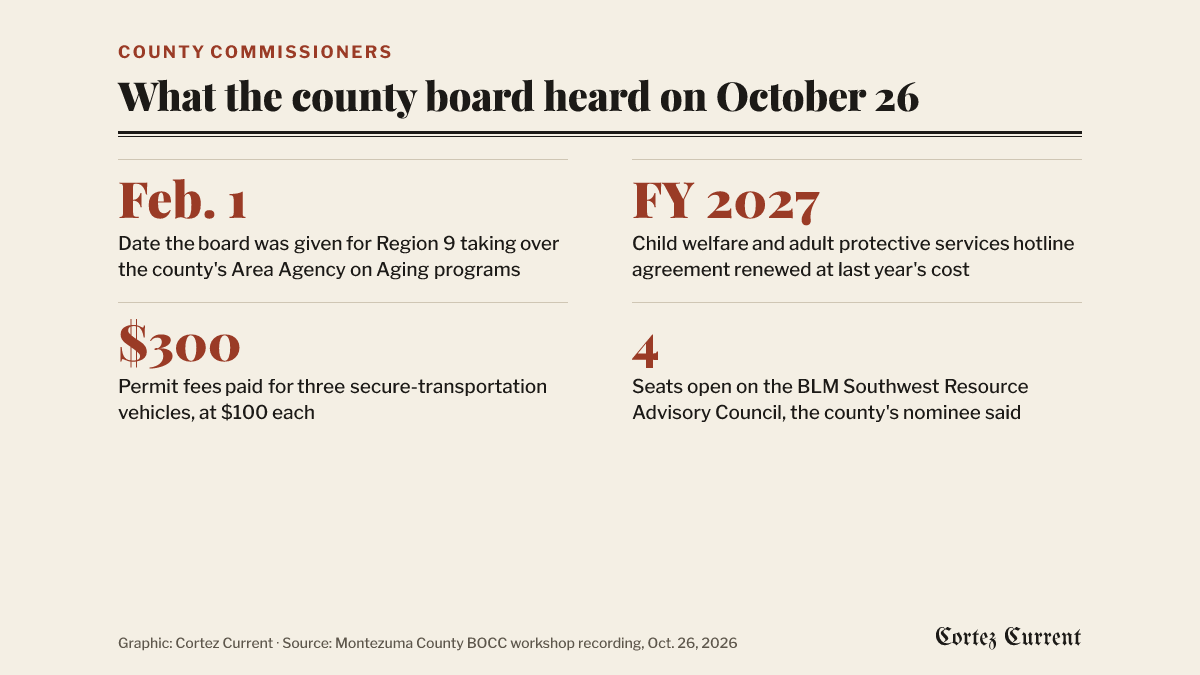 Graphic: Cortez Current. Source: Montezuma County BOCC workshop recording, October 26, 2026
The commissioners sat first as the Board of Social Services, approving the minutes of their September 28 session and the month’s financials and payables. The figure read into the record was not clear enough on the recording to print.
They then approved the county’s annual memorandum of understanding for the hotline that takes child welfare and adult protective services calls. The director said the hotline is run by another Colorado county’s call center, which operates 365 days a year, and that the contract is the same as last year with no increase in cost. The motion was to sign it for fiscal year 2027; it passed on a voice vote with no commissioner heard objecting. The county attorney said he had nothing to add.
What the board was told about its own caseload
The director’s report ran longer than the votes. On adult protective services, she said three case workers had attended the state’s Elder Justice Summit on scholarships, and that another was in Mesa County this week for training on financial exploitation — a category she said has become steadily more common and now involves cases where “hundreds of thousands of dollars” have been taken from older and vulnerable residents. She described those cases as complicated.
On child welfare, she said the department had put a new case-documentation tool into use the previous week and that she had tried it herself on one high-needs youth case. The state’s Administrative Review Division had audited every assessment and in-home case in the department, she said, with results due in December, and that the department had done well on which reports it screened in and which it screened out. She is also sitting on a state work group rewriting the rules under the Indian Child Welfare Act, which she said matters locally because the county carries a number of those cases.
She reported no new information on the SNAP cost share, the shift of food-assistance administration costs onto counties that she has raised with the board before.
On senior services, she said the program manager had left and a successor who had worked as a substitute cook for the program had taken over, with a two-week handover. The Current is not naming either person: the recording is the only source and auto-captioning is not reliable enough for names.
She also told the board she had gone to the Town of Mancos to ask for financial support for the coming year and had made the same proposal to the Town of Dolores, and that she did not yet know how either would land. Neither town has published anything about a request.
The board agreed to her suggestion that she walk them through the social services budget line by line at their November work session.
The workshop: a youth prevention deal and three letters
Moving into the workshop proper, Public Health Director Bobbi Lock brought a new memorandum of understanding between her department and the School Community Youth Collaborative, funded through the county’s EPIC grant — Elevating Prevention in Colorado. Under it, she said, the collaborative subcontracts to do the youth-facing work the grant pays for, and she set out which responsibilities fall to each side. The county attorney said he had reviewed it and found no legal problems. The board gave her the go-ahead, and the agreement was down for the consent agenda at the board’s next meeting rather than a vote at the workshop.
Lock also brought the annual permit renewal for a secure transportation company, which moves people under medical or protective custody. The company has an existing three-year license and was renewing the yearly permits for three vehicles — different vehicles from last year, she said, each inspected and documented, with $100 per vehicle and $300 paid in total. The permits need the board’s approval and then a permit number assigned by the Clerk and Recorder. Asked whether the vehicles meet accessibility requirements, Lock said the paperwork covers partitioning and restraints and that the company is responsible for obtaining its own mechanical and vehicle inspections. She told the board a second company, currently operating in La Plata and Archuleta counties, has applied to work in Montezuma County and that she would bring that application forward later.
The board then took two letters of support, both brought by James Dietrich, who handles natural resources and noxious weeds for the county. The first backs his own reappointment to the Bureau of Land Management’s Southwest Resource Advisory Council, which would be his third term. He told the commissioners he had never managed to sit a full three-year term because the council keeps lapsing, that he believed four seats are currently open, and that his reading of it was political turmoil inside the agency. The commissioners said they had no questions and supported it.
The second letter backs the U.S. Forest Service’s annual application to the state and Colorado Parks and Wildlife for help maintaining motorized trails. Dietrich said this year’s request follows the usual pattern, and named one Montezuma County maintenance project covering the Chicken Creek trails near Mancos. The other project names on the recording were not clear enough to print.
Roads after the rain
With the agenda finished, the board’s chairman read out a note he said Road and Bridge had emailed him about the past several days of rain, and the department’s account is now in our running story on the county’s roads: county roads are open after the rain.
The recording is Montezuma County BOCC Workshop October 26, 2026, posted with the county’s own agenda for the meeting. Figures and names in this story were checked against that agenda; where the auto-generated captions were the only source for a name or a number, it has been left out and the person described by their role. Written minutes for the meeting have not yet been posted.