Busic backs Valley Range; Cox says no one has seen the plan
The Democratic candidate for county commissioner says opponents of the battery site are spreading misinformation. A neighboring business says it's being unfairly targeted. Republican Rodney Cox, who said last month he was "against everything" about the project, now says he won't decide until he sees the plan.
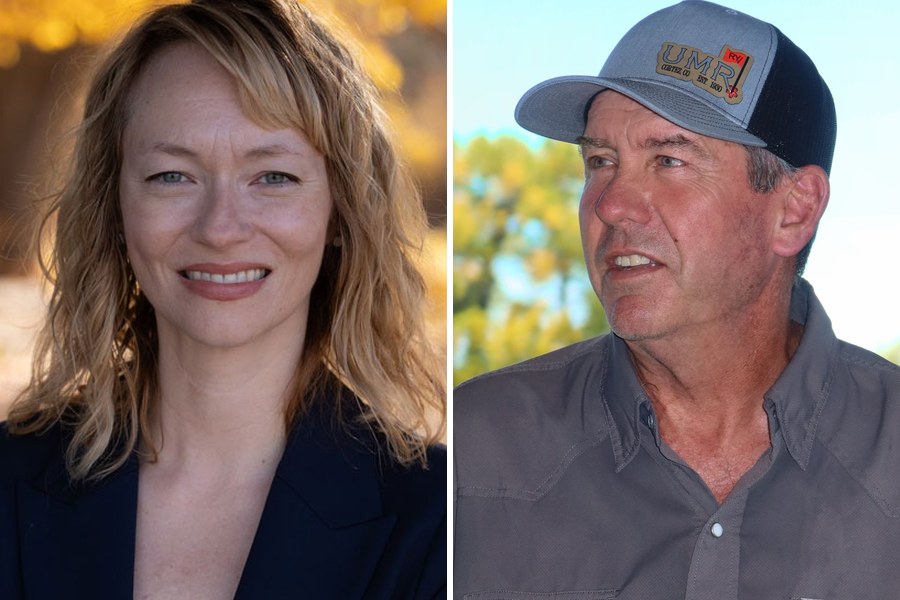
Rebecca Busic, the Democrat running for Montezuma County commissioner, has come out strongly for the Valley Range Energy Park. Her statement has set off an online fight with neighbors of the proposed site less than two weeks before Election Day.
Her Republican opponent, Rodney Cox, says no one, Busic included, can know whether the project meets county rules until the application is made public. “Has she seen the plan?” he asked.
“I do support this project,” Busic wrote in a long post on her campaign Facebook page on Oct. 16. She said a small group of people was spreading misinformation by comparing Valley Range to the January 2025 battery fire at Moss Landing, California.
The two projects are different, she wrote. Moss Landing used nickel-manganese-cobalt batteries stacked inside a former power plant. Valley Range plans lithium-iron-phosphate batteries in separate outdoor containers, and 62.5 megawatts of storage instead of Moss Landing’s 300.
Busic wrote that the people making the comparison “are actually most closely located to where the project will be sited - meaning they are acting in their own personal interest.”
“I don’t blame them for being upset, but fear mongering isn’t the right way to go about this,” she wrote. “I do feel for these people, but it is not the job of the commissioners to make decisions in the best interest of the loudest few, but the best interest of our county.”
She pointed to the county’s rules for large-scale solar, which commissioners adopted unanimously in November 2025 as a new chapter of the land-use code, after a six-month moratorium. She said the project fits them. Rejecting projects people simply don’t like, she wrote, could lead to lawsuits costing the county hundreds of thousands of dollars.
Many people say they support renewable energy, she wrote, but “you don’t actually support it if you don’t support it where you live.”
Busic also tied the project to county finances, saying renewable energy, a sales tax or a lodgers’ tax could help close a budget gap. The county’s proposed 2027 budget draws $2.6 million from reserves to balance the general fund, Robert Dobry told commissioners Oct. 13. At that pace the county has about three years before reserves hit the board’s minimum, he said, and before 2029 it “will either need community support for additional funding” or make significant cuts to services.
On data centers, Busic repeated her call for a county moratorium. She said the developer told her no data center is planned at the site, and that her opponent has refused to back a moratorium. Cox calls that untrue. Valley Range’s new owner also controls a data-center company.
She closed by acknowledging the stand could cost her votes. “I have a four year old son,” she wrote. “If I lose this race because I am supporting a more habitable future for him and every other child on this planet, by God I will be proud to do it.”
Busic did not respond by the Cortez Current’s noon Friday deadline to questions about a post the neighbors say she removed, the neighbors’ argument about battery smoke, and Cox’s statements.
Where Cox stands
Cox said he won’t take a position on a plan he hasn’t seen. “How can I comment on a plan I have not seen? How can anyone say it fits the code if they have not seen the plan?” he wrote Thursday in answers to questions from the Cortez Current. “Has she seen the plan?” The roughly 1,000-page application has not been posted for public review.
Cox said he has public-safety concerns about the battery system, noting that the local fire district has not taken a position and that mutual-aid agreements with surrounding districts are not in place. “I can’t/won’t make a decision based on speculation, not data,” he wrote. “I will make data driven decisions based on facts and will never approve something that compromises public safety.”
That is more cautious than his remarks at a Sept. 23 candidate forum in Dolores, where KSJD quoted him saying, “There is a solar farm being proposed now and I’m against everything about that.” At the same forum he said a commissioner would have to approve a legal project that fits the land-use code. Asked how the two fit together, he wrote that until the application is open for review, “it would just be speculation at this time.”
Cox called Busic’s statement that he refused to support a data-center moratorium “untrue.” “I never said I refused to support a moratorium,” he wrote. “What I said is that if a data center is going to draw on our water, I’m out! I’ll fight it tooth and nail.” He did not say whether he would support a moratorium. He also wrote that the county already has a small data center, which the Cortez Current could not confirm.
On the budget, Cox said nothing would close the $2.6 million gap in the short term besides “a thorough scrub” of spending once he is elected and has met with department heads and elected officials. He said the solar project would take two years to build before producing revenue, and estimated the county’s share at less than 1% of the 2026 budget, or about 4.5% of the shortfall, roughly $117,000. Accelergen has estimated the project would pay $13.9 million in local property taxes over 35 years, Colorado Public Radio reported, and said the final amount depends on the facility’s value once built; that estimate does not break out the county’s share.
Neighbors respond
The pushback came in The Original What’s Up? Dolores, Mancos, Cortez!, a Facebook group with about 25,000 members.
Dotty Wampus Magical Chocolate Factory, a chocolate shop on County Road H at the base of Mesa Verde, south of the project site, posted in the group that Busic had publicly accused the neighborhood of spreading misinformation. The shop’s owners, Bryan Davis and Joanne Haruta, run NoValleyRange, a group of neighbors from two nearby neighborhoods that is collecting petition signatures against the project. The shop’s post cited research it said shows lithium-iron-phosphate batteries give off more toxic gases than nickel-manganese-cobalt batteries when they burn, and asked why a commissioner candidate was speaking for “a billionaire developer.”
Accelergen, the Austin, Texas, company developing Valley Range, changed hands this month. Fengate Asset Management, a Canadian infrastructure investment firm, announced that one of its funds had bought Accelergen’s portfolio of seven solar-and-battery projects, including Valley Range, and invested in the company itself, according to trade reports. Accelergen’s management team stays in place. Fengate is not a billionaire; it is an investment manager with about $8 billion in capital commitments, Data Center Dynamics reported.
In comments under its post, the shop said its fight is with Accelergen, not the candidate. “My adversary is the billionaire developer, not Mrs. Busic,” it wrote. “I was accused of lying by Mrs. Busic on the eve of her election. I don’t know why she did that. But it’s not OK.”
“It’s not the project. It’s the location,” the shop wrote in another comment. “The batteries are dangerous and have no business next to a campground, tourist businesses and a residential neighborhood.”
The shop said it was not opposed to battery storage in principle. “The technology exists to safely build one of these, it’s called a sodium-ion battery. But that’s not what we’re getting,” it wrote. Sodium-ion batteries are a newer chemistry just reaching grid scale: the first U.S. grid-scale system went into service in Watkins, Colorado, in 2025, and the first U.S. factory dedicated to them is expected to start production next year, pv magazine USA reported.
The shop said its concern is the smoke from a battery fire rather than the fire itself, calling Moss Landing “an EPA disaster site because of the chemicals released during the fire - not because of the fire itself.” It asked Busic for “a new post that tells the truth about the LFP batteries,” adding, “A public apology would also be nice.” The shop also said Busic had taken down an earlier post on the subject. Busic did not respond to a question about the post.
Davis did not respond to questions emailed by the Cortez Current on Wednesday. Thursday morning his shop’s Facebook page ran a paid ad with a map of the site, urging people to sign the petition and attend the public hearings. The ad says it is paid for by neighbors of the project and others who donate. It describes Valley Range as the work of “a TEXAS developer owned by FENGATE (the largest data center company in Canada).”
That is partly accurate. Fengate’s fund now owns the project, but Fengate is an investment firm, not a data-center company. It does hold a majority stake in eStruxture, a Canadian data-center operator with 15 centers, after leading a C$1.8 billion investment in 2024, Data Center Dynamics reported. Accelergen did not answer a question about whether the new ownership changes any plans for the site.
The ad also says the battery site will cover 8 acres and that there were 22 battery fires at U.S. storage plants from 2019 to 2025. The Cortez Current could not confirm that count. The Electric Power Research Institute reported this month that battery-storage failures per unit installed fell 98% worldwide from 2018 to 2025, and that no U.S. injuries or deaths have been reported from such failures since a 2019 fire in Surprise, Arizona, injured four firefighters, Energy-Storage.News reported.
The shop’s post had drawn 168 comments by Thursday morning, with residents arguing both sides. Some disputed the shop’s reading of Busic’s statement. “I do not see where she accused ‘your neighborhood’ of spreading misinformation,” John Early wrote, pointing to her words “a small group of people.” The shop answered that its neighborhood is that small group.
Bob Waggoner, who supports the project, wrote, “I find it refreshing when a political candidate makes a clear statement of their position on something.” He called claims that Busic was being paid for her position “utterly baseless.”
Neighbors of the site pushed back. “We are not against solar energy,” Robin Smith wrote. “An industrial scale solar farm should not border private residences and outdoor tourist businesses.”
Some comments turned personal, including insults aimed at Busic.
The research supports parts of both sides. A 2024 review of about 60 studies, led by University of Sheffield researchers, found that gas from burning lithium-iron-phosphate cells is more toxic and more flammable than gas from nickel-manganese-cobalt cells, though the nickel-based cells release more gas overall. Tests by UL Research Institutes found the nickel-based cells burned more than twice as hot and gave off far more gas. Donal Finegan, a battery researcher at the National Laboratory of the Rockies, told Colorado Public Radio the iron-phosphate chemistry tolerates higher temperatures and releases fewer toxic particles if it burns, but can still go into thermal runaway, a point an Oxford commentary in the journal Fire Technology also makes.
The project
 An aerial photo published on the Valley Range Energy Park website. Photo: Valley Range Energy Park
Accelergen Energy proposes about 900 acres of solar panels generating up to 125 megawatts, plus the 62.5-megawatt battery system, east of Cortez and about three miles north of Mesa Verde National Park. Empire Electric and three other rural electric co-ops announced Oct. 5 that they would buy the power if the county approves the project, and estimate more than $20 million in savings. Empire General Manager Josh Dellinger said the project could bring long-term revenue that eases pressure on members’ rates.
The company told Colorado Public Radio it moved the battery area in response to neighbors’ concerns and that the nearest home would now be about 1,800 feet from it, well beyond the county’s 500-foot requirement. The batteries would sit in outdoor containers covering less than an acre inside a 10-acre fenced area.
The company filed a roughly 1,000-page application with county Planning and Zoning in early September. It expects a planning hearing in December and a commissioners’ hearing next year, though the county hasn’t confirmed those dates. Construction would not start before early 2029.
Accelergen’s public relations firm, Bantam Communications, said Thursday the company would answer the Cortez Current’s questions about the battery site, setbacks, emergency plan and new ownership, but no answers arrived by the noon Friday deadline. This story will be updated if they do.
Anyone who wants to weigh in on the project in writing will face new rules. Commissioners voted unanimously Oct. 20 that, starting Nov. 1, written comments on land-use applications must be filed through the county’s planning portal at least seven days before each hearing, with no new written material accepted at the hearings themselves.
Cortez Fire Protection District Chief Roy Wilkinson has said the district won’t move forward until there is a solid emergency action plan. Commissioner Kent Lindsay, vice president of Empire Electric’s board, told Colorado Public Radio he is still consulting lawyers about whether to step aside from the vote.
Busic and Cox are running for the seat held by term-limited Commissioner Jim Candelaria. Election Day is Nov. 3.
Sources: Rebecca Busic for Montezuma County Commissioner, Facebook statement, Oct. 16, 2026 · Rodney Cox, emailed answers to the Cortez Current, Oct. 22, 2026 · Dotty Wampus Magical Chocolate Factory post and comments, The Original What’s Up? Dolores, Mancos, Cortez! · Dotty Wampus paid ad, Oct. 22 · NoValleyRange · Montezuma County BOCC meeting, Oct. 13, 2026 · Montezuma County BOCC meeting, Oct. 20, 2026 · KSJD, Sept. 24 · KSJD, Nov. 18, 2025 · Colorado Public Radio, Oct. 14 · Empire Electric Association, Oct. 5 · Enerdatics on Fengate and Accelergen, Oct. 9 · Data Center Dynamics on Fengate and eStruxture · Bugryniec et al., Journal of Energy Storage, 2024 · Edwards and Dobson, Fire Technology, 2025 · UL Research Institutes battery tests, 2022 · Energy-Storage.News on EPRI failure data, Oct. 2026 · pv magazine USA, July 13 · Cortez Current, Oct. 14