At KSJD, the news director is also the DJ at the Pride party
Colorado votes on two transgender ballot measures in three weeks. KSJD is covering both, much of its political coverage runs through one person, and the station won't say who checks that person's work. We asked. The station chose silence.
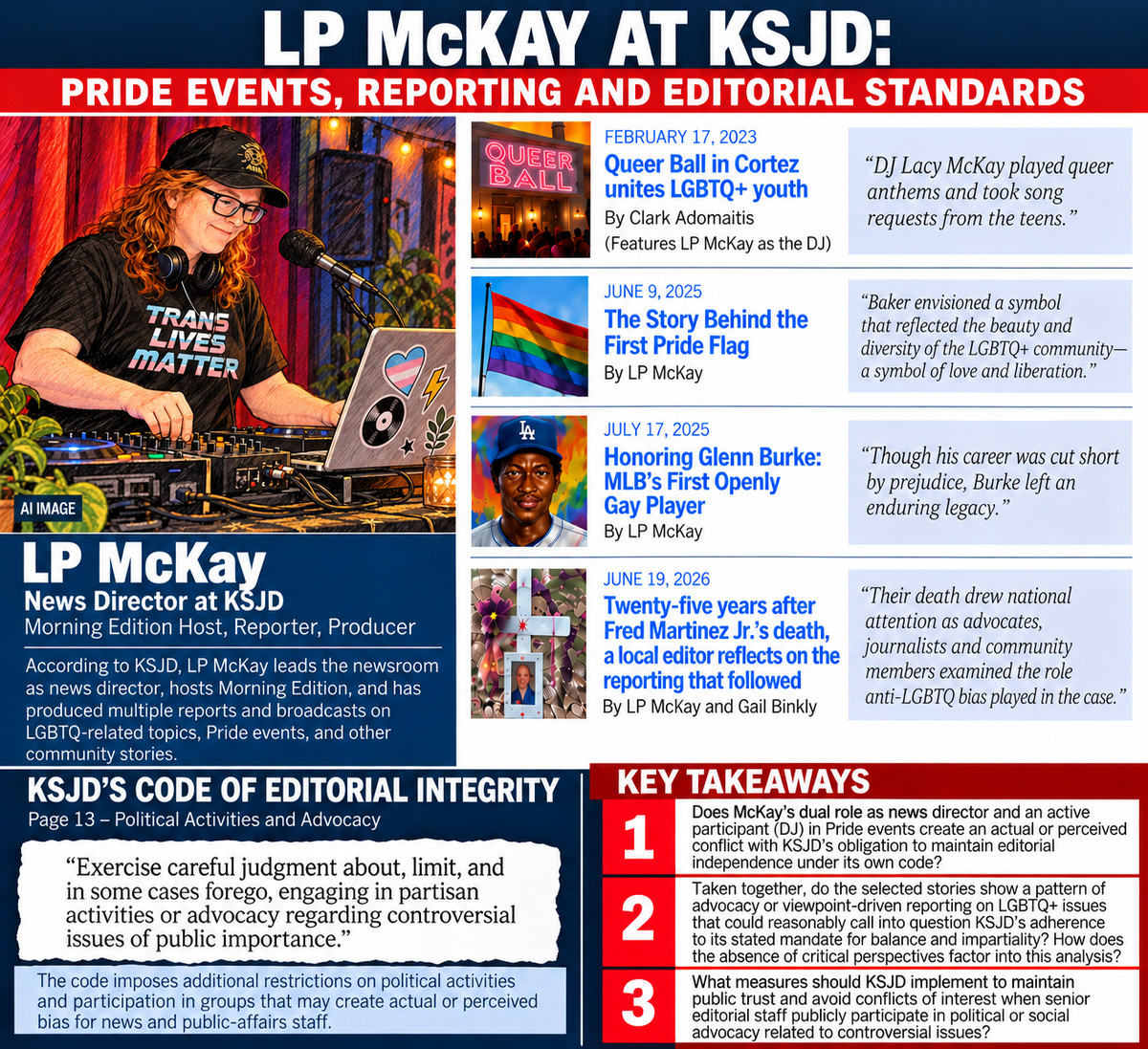
A DJ takes requests. A news director answers questions. At KSJD, LP McKay does the first. Nobody at the station, it turns out, does the second.
On Friday, October 9, at noon, The Cortez Current emailed KSJD and McKay several questions about how the station applies its own ethics code to its own news director. The deadline was 5 p.m. Monday. That is three full days, a weekend and a business day, to answer questions a functioning newsroom could answer from memory. Nothing came back. Not a decline, not a “we’ll get back to you,” not a form letter. It is not the first time this newspaper’s questions to KSJD have gone into a hole.
Silence is a choice. Here is what KSJD chose not to talk about.
The rule KSJD wrote for itself
In September 2016, Community Radio Project, the nonprofit that holds KSJD’s license, adopted a Code of Editorial Integrity. Nobody imposed it. KSJD’s board wrote it, approved it and published it. Three of its provisions are the whole story.
It tells senior news staff, the people who make final editorial decisions, not to take part in activities “supporting, opposing, or espousing views on controversial issues of public importance.” Its own list of examples: running for office, rallies, marches, demonstrations, petitions, lawn signs, bumper stickers.
It tells the same people to stay out of groups whose activities “may give rise to real or perceived bias.” Not just real bias. Perceived. The station put the public’s reasonable impression into its own rulebook.
And it requires decision-makers to disclose conflicts to colleagues and step out of decisions where a conflict exists.
The code does say the station respects employees’ personal lives, and its examples do not mention Pride parties, DJ sets or T-shirts. Fine. Then KSJD should be able to say, in a sentence, why those fall outside the rule. It has had since Friday. It has had, really, since 2016.
What the news director was doing in June
On June 6, McKay was the DJ at a Pride Month dance party at ZU Gallery in Cortez. A photograph from the event shows McKay in a shirt reading “TRANS LIVES MATTER.” The Journal wrote it up on June 23, describing McKay’s work organizing LGBTQ gatherings after moving here from Austin, and quoting McKay directly: “I try to be as visible as possible.”
As visible as possible. That is a fair description of an organizer. It is the opposite of what KSJD’s code asks of the person running its newsroom.
Let’s be exact about what this does and does not show. The dance was a celebration, not a campaign event. The shirt expresses solidarity with transgender people; it does not take a position on girls’ sports or on surgery for minors. I have found no public statement from McKay for or against either ballot measure, and no evidence McKay has tilted KSJD’s coverage of them. McKay is entitled to convictions, friends and a life outside the station, and nothing here says otherwise.
But KSJD’s code lists lawn signs and bumper stickers, which are short public messages on contested subjects. A slogan on a shirt, at a public event, photographed and published, is the same category of speech. And transgender policy is, this fall, the single most contested issue on Colorado’s ballot. It appears there twice: Proposition 134, on sex-based eligibility for school and college sports, and Proposition 135, on surgeries for minors and the public funding and insurance that pay for them. The Cortez Current reported on both measures on October 7.
KSJD may read its code differently. It may believe solidarity is not advocacy. That is an argument a station can make in public. KSJD has declined to make it.
A ballot guide with no author
On October 6, KSJD published a guide to all 14 statewide ballot measures, with arguments for and against each. Useful. Here is what readers cannot learn from it: who wrote it, who edited it, who checked the summaries of Propositions 134 and 135 against the Blue Book, and who signed off. There is no byline. The only name attached to the guide itself is in the photo credit: “LP McKay / KSJD.”
A photo credit is not a byline, and I am not claiming McKay wrote the guide. I am pointing out that nobody can tell, and that KSJD, asked directly, would not say. A newsroom that cannot name the author of its own election guide three weeks before an election is not protecting a source. It is avoiding a question.
What is not in doubt is how much of KSJD’s political coverage runs through McKay. On September 23, McKay moderated the Montezuma County commissioner forum in Dolores, sponsored by the county Democrats, with Republican Rodney Cox and Democrat Rebecca Busic on stage. Moderating a two-party forum is ordinary journalism, and the sponsor proves nothing about fairness. But add it up: the news director supervises election coverage, moderates the candidate forum, and is the one name attached to the ballot guide. At KSJD, local political coverage is mostly one person. The code was written for exactly that situation.
The newsroom McKay inherited
This is not a newsroom with a clean record on keeping reporting and opinion apart. In February 2023, KSUT and KSJD published “Queer Ball in Cortez unites LGBTQ+ youth,” a news story about a youth event where McKay was, again, the DJ. In the reporter’s own voice, with no attribution, the story informed readers that “transphobia and homophobia have infiltrated local politics.”
That is not reporting. That is a verdict. McKay did not write it and, as far as the record shows, did not approve it. But it ran on KSJD, as news, and McKay now runs KSJD’s news. The question is not whether McKay wrote that sentence. The question is whether anyone at the station would stop the next one.
Because this community is not of one mind. In May, the Cortez City Council passed a Pride Month proclamation 5-2, after an open disagreement about whether city government should be recognizing identity groups at all. People on the losing side of that vote are KSJD’s listeners too. They are asked to donate too. Holding traditional views about sex and gender does not make them bigots, and they are owed coverage that does not, as news, call them a problem that has infiltrated their own town.
And the standard cuts both ways. If a news director spent weekends DJing events for the traditional-marriage crowd in a shirt to match, and then supervised coverage of the same two measures, every question here would still be fair. The test is consistency, not whose cause it is.
The questions, still unanswered
Here is the heart of what we asked. KSJD can answer these anytime it likes.
- Is the 2016 Code of Editorial Integrity still in force? Does its limit on outside advocacy apply to the news director? Where does KSJD draw the line between community celebration and advocacy, and who draws it?
- Who reviews politically sensitive coverage when a senior journalist’s public activities touch the issue being covered? Is there any independent review at all?
- Who wrote, edited and approved the October 6 ballot guide? What role did McKay play, and who checked the summaries of Propositions 134 and 135?
- Who evaluates a real or perceived conflict involving the news director? Has KSJD considered disclosure, outside review or recusal for its coverage of the two measures?
None of these assumes wrongdoing. All of them have short answers if the safeguards exist. The simplest explanation for a station that will not give short answers is that it does not have them.
What silence tells you
The record is not complicated. McKay runs KSJD’s newsroom. McKay is a public, visible participant in Pride events. KSJD has a written rule restricting exactly that kind of participation by exactly that kind of employee. KSJD is covering two ballot measures on exactly that subject. And KSJD, asked how those facts fit together, said nothing.
There is a difference between demanding that a journalist abandon convictions, which is neither fair nor realistic, and expecting a news organization to explain its own safeguards, which is the minimum. KSJD wrote the rules. KSJD employs the news director. KSJD publishes the election coverage. KSJD could have explained the three in an email. It had the weekend.
KSJD asks this community for its trust and its money, on air, every year. Trust is earned by answering questions, not by ignoring the people who ask them. Until the station can say who checks its news director’s work, listeners who are asked to give have a fair question of their own: what, exactly, are they paying for?
Disclosure: The Cortez Current competes with KSJD for local news audiences. The author was a candidate for Cortez City Council in 2026 and was quoted by KSJD opposing the city’s Pride Month proclamation.
Request for comment: The Cortez Current emailed KSJD and LP McKay its questions on Friday, October 9, 2026, with a deadline of 5 p.m. Monday, October 12. No response was received. The Cortez Current will publish any substantive response from KSJD or McKay, and will correct any factual error brought to its attention.