Amendment 87 would swap Colorado's flat income tax for six brackets
The measure on Montezuma County ballots would cut income tax for taxable income under $500,000 and raise it above that, for an estimated $2 billion a year. A second measure, Proposition 136, would cap the rate where it is.
Montezuma County voters deciding the November 3 ballot have two statewide questions on the state income tax, and they point in opposite directions. Amendment 87 would end Colorado’s single flat rate and replace it with six graduated brackets starting in 2027. Proposition 136 would write the current 4.4 percent rate into state law as a ceiling.
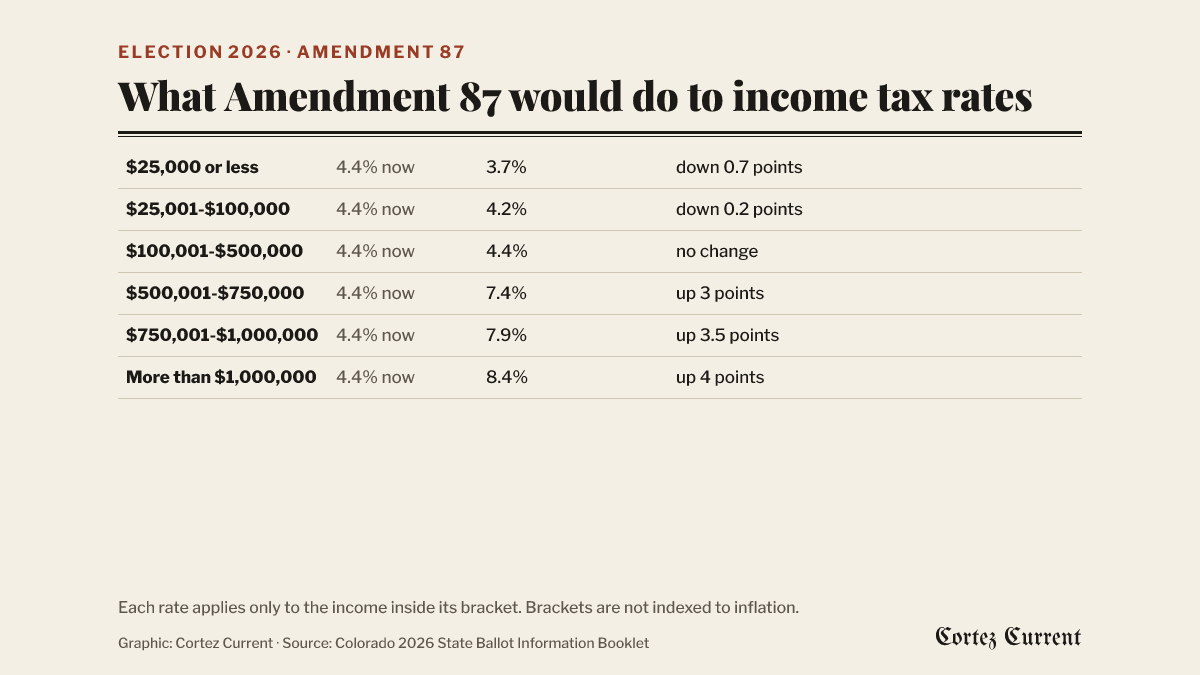 Graphic: Cortez Current. Source: Colorado 2026 State Ballot Information Booklet
What Amendment 87 would do
Colorado has taxed income at one flat rate since 1987, and the Taxpayer’s Bill of Rights requires it. The rate is now 4.4 percent, and it applies to individuals and businesses alike.
Amendment 87 would remove that constitutional requirement and set six brackets, each rate applying only to the slice of taxable income inside it, the way federal income tax works. Taxable income is the portion of income that is actually taxed, after deductions, so it is smaller than what a household earns.
For individuals and businesses with taxable income under $500,000, the measure lowers the tax bill, by at most $325 a year. Above roughly $500,000, it raises it. The state’s ballot information booklet gives worked examples: a taxpayer with $125,000 in taxable income would owe $5,175 instead of $5,500, a saving of $325; one with $625,000 would owe $30,925 instead of $27,500, an increase of $3,425; one with $2 million would owe $143,925 instead of $88,000.
Unlike the federal brackets, the new state brackets would not be adjusted for inflation. The booklet says that means more of taxpayers’ income will fall into the higher brackets over time.
Where the money would go
The state estimates the change would bring in about $2 billion more in income tax in its first full year, and more after that, though actual collections could be higher or lower.
That money would have to be spent on K-12 education, health care, and early childhood care and education, and it would have to add to what the state already spends on them rather than replace it. The legislature would decide which programs get how much. The state would also have to publish an audited annual report on how much extra was collected and how it was spent.
The additional revenue would be exempt from the TABOR revenue limit. The booklet is explicit that this does not change TABOR refunds: the limit and the amount of revenue counted against it stay the same, and estimated refunds do not change. It projects the state collecting $15 billion in income tax in 2028 under current law and $17 billion under the measure, with the extra $2 billion outside the limit.
The arguments the state booklet prints
Supporters, in the booklet’s summary, say the measure cuts taxes for 97 percent of taxpayers, including most households and small businesses, while raising them only on top earners; that it funds schools, health care and child care at a time when federal policy changes put those services at risk; and that a graduated income tax is not an experiment, since the federal government and 27 other states use one.
Opponents, in the same booklet, call it a multibillion-dollar tax increase that would make Colorado a less competitive place to start and grow a business, could push some high earners and employers out of the state and cost jobs at every income level, and would reach further down the income scale each year because the brackets are not indexed to inflation.
The local voice so far
Karen Sheek, president of the Montezuma County League of Women Voters, supports Amendment 87, and the statewide League has endorsed it, KSJD reported on October 21. Sheek told the station that the top rate would not apply to a high earner’s whole income — “People that are making a million dollars or more are not going to be paying the highest rate on their entire income,” she said — which is how bracketed rates work.
Proposition 136, and what happens if both pass
Proposition 136 would set the state income tax rate for individuals and corporations at no more than 4.4 percent from January 1, 2027. It does not change today’s rate, and the state’s fiscal analysis finds it has no effect on revenue or spending at all. It would not stop future cuts either: the legislature or a citizen initiative could still lower the rate, and the constitution already requires voter approval for any increase.
If voters pass both, Amendment 87’s rates above $500,000 would exceed Proposition 136’s 4.4 percent ceiling. Normally the measure with more votes prevails where two conflict, but the booklet says the outcome here is unclear and that the legislature or a court would have to sort it out.
Fourteen statewide measures are on the November 3 ballot. We have also covered Propositions 134 and 135, on school sports and surgeries on minors. The state’s nonpartisan ballot information booklet, the Blue Book, analyses each one and is posted on the Colorado General Assembly’s website; the Secretary of State lists the organizations supporting and opposing each measure.
For local questions, drop box locations and in-person voting hours in Montezuma County, see our voter guide.
Sources: Colorado 2026 State Ballot Information Booklet · KSJD