Cortez council sends the 2027 budget to a Nov. 24 hearing
The $39 million budget passed its first reading unanimously on Tuesday, along with a $70,000 contract for the municipal judge and a resolution the police department needs to collect at least $15,000 from a statewide fund. The mayor and two council members pushed back on a state-required study that says Cortez needs 1,045 more homes.
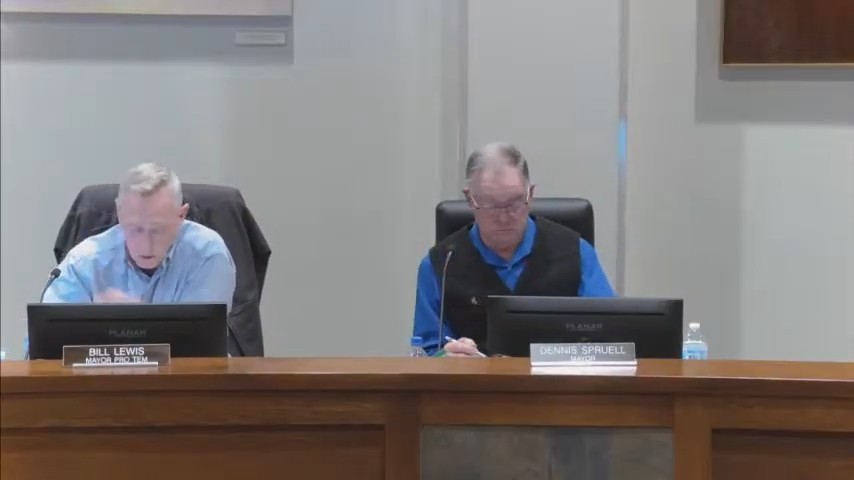
The Cortez City Council passed its 2027 budget on first reading on Tuesday night and set the public hearing for Nov. 24, in a meeting that also locked in a new contract for the city’s municipal judge and cleared the way for the police department to collect its share of a statewide training fund.
Every vote was unanimous. Councilmember Clarisa Osborn was absent; the mayor said she was unwell. The Current previewed the agenda last week.
The budget
Ordinance No. 1378, Series 2026, is the city’s 2027 appropriation. Finance Director Randy Bailey took it through on first reading, and Councilmember Bill Lewis moved it with the second reading and public hearing set for Nov. 24.
Bailey put 2027 expenditures at about $39 million — roughly $32.5 million of operating expense and $6.5 million of capital, split close to evenly between the governmental and enterprise sides. The capital work he named: water system improvements drawn from the first year of the city’s recently adopted water master plan, rehabilitation of the natatorium at the recreation center, and continued street projects. His memo in the packet puts the reserve draws at $5.4 million in total, of which $1.7 million comes from the General Fund.
On the general fund, Bailey said revenue is down about 3.6 percent year over year, to about $14.8 million, and that the budget asks for $1.7 million from general fund reserves to support capital and keep services going. General fund expenditure, he said, is down about 3.2 percent, or about half a million dollars, from the prior year.
His memo adds the reasoning behind leaning on reserves: fund balances currently hold more than six months of estimated annual operating expense, which the memo calls a prudent position from which to pay for one-off capital work, with continued monitoring of reserve levels.
Bailey pointed council and the public to a new public works storyboard mapping street projects and their timing, and to the city’s ClearGov transparency page, where a draft of the 2027 budget sits and comments can be left.
Mayor Pro Tem Bill Lewis thanked Bailey for absorbing unexpected costs connected with the outdoor pool “without impacting salaries.” The pool’s 2027 funding has been through two turns already this autumn. Mayor Dennis Spruell told residents the budget is on the city’s website and that the finance director will answer questions: “I see time and time again where they say, ‘Well, we just didn’t know.’”
A $70,000 contract for the municipal judge
Council approved a 2027 professional services contract with Padilla Law, PC, for municipal judge services, and authorized the mayor to sign it. City Attorney Patrick Coleman presented it; Judge Beth Padilla was in the room.
Coleman explained why the contract is being rewritten rather than amended again. The council has three direct reports — the city manager, the city attorney and the municipal judge. The first two have employment agreements, the judge a professional services agreement, and all three have been amended repeatedly as caseloads and hours changed. Council replaced the manager’s and the attorney’s base contracts this year for the same reason: “it became kind of unwieldy having multiple amendments and a base contract.”
The new contract runs from Jan. 1, 2027. It pays Padilla Law $70,000 a year, in monthly payments of $5,833.33, and — this is the change from earlier versions — does not tie the money to a set number of hours. The firm invoices monthly and the city pays within 30 days.
The term renews annually unless terminated, with the non-appropriation clause Colorado law requires on any multi-year obligation. Either side can end it for material breach on five days’ written notice, with the breaching side given that time to cure and the other side free to accept the cure or not. Either side can also end it for convenience on 30 days’ notice. If the city ends it without cause and without giving at least three months’ notice, it owes a lump sum equal to three months’ compensation, and in return the firm waives claims arising from the termination.
“Just cause” is defined narrowly in the signed text: conviction of Beth Padilla of a felony under Colorado law or of an offense involving fraud, theft, misuse of public property, embarrassment to the city or moral turpitude; her failure to keep her Colorado law license in good standing; or Padilla Law’s failure to stay a Colorado corporation in good standing. The contract also records that Article VI, Section 2 of the city charter controls when a municipal judge can be removed during her term, and that the judge serves at the pleasure of council.
Councilmember Claire West moved it. “I think Judge Padilla has done an outstanding job as our municipal judge and gone above and beyond the original contract,” she said.
$15,000 for police training
Resolution No. 18, Series 2026, passed unanimously. Police Chief Vern Knuckles told council it commits the city and the department to spend money from the state’s Peace Officer Training and Support Fund the way the statute requires, which is what the Division of Criminal Justice needs before it will send any.
The fund came out of Proposition 130, which voters passed in 2024, and Senate Bill 25-310, and sits at C.R.S. 24-33.5-122. Every certifying agency gets at least $15,000; anything above that is divided among certifying agencies by a statewide formula once the deadline passes. “I don’t know exactly how it works,” Knuckles said of the formula.
Asked whether the paperwork was worth it, he said it was: the department has to certify how many certified officers it has, get the resolution, and send a copy of the proposed 2027 budget. Asked how freely the money can be spent, he was candid that the ballot language was broader than the law turned out to be. “Reality is it’s pretty narrow,” he said. It can go to training and to compensation — pay for officers, hiring bonuses, reimbursing an officer who paid his own way through the academy. His memo adds that the money must be spent on top of what the city already spends on those things, that no city match is required, and that the state has asked for resolutions by Nov. 30 against a statutory deadline of Dec. 15.
“It still feels a little high”: council on the housing study
The evening’s one presentation was the 2026 regional housing needs assessment, which Colorado’s 2024 housing law, Senate Bill 24-174, requires every jurisdiction of 1,000 or more residents to produce every six years. Rather than have each town buy its own, the Region 9 Economic Development District had one assessment made for the five counties and ten towns of Southwest Colorado. Shak Powers, the district’s deputy director and regional projects manager, presented it. No vote was asked for; council’s feedback goes to the state with the final report, which is due Dec. 31.
The Current set out the figures last week: 1,045 homes needed in Cortez over ten years, about 105 a year against about 25 being built, with 275 of them to catch up with today’s shortage and 770 to keep up through 2036.
What was new on Tuesday was the council’s reaction to the headline number, and it was skeptical.
The mayor pressed first. The 1,045 figure rests on an assumption that everyone who works in Cortez would live in Cortez, and a lot of the people who work in the city live in the county, in Mancos, Dolores, Dove Creek or Towaoc. “It’s kind of a number that,” he began, and Powers finished the thought: “That’s correct.”
Powers did not retreat from the study, but he did draw the line himself. “I wouldn’t say the number’s entirely fictitious. We don’t have enough housing. We especially don’t have enough rental units,” he said. “But we also don’t have a thousand people living on the streets.”
A councilmember said the picture of Cortez largely felt right but that the number “still feels a little high,” pointing out that the city’s population grows about 2 percent a year, which would suggest a need nearer 20 percent over ten years than close to 50. Another said the figure does not account “accurately based on our geography and the reality of commute working and remote working.”
Powers made the same point in reverse: the estimates are not driven by population change alone but by in-migration of workers. He said Cortez compares well in the region on the gap between what it costs to live somewhere and what people there earn — “the second smallest gap in the region” — and that Durango, by contrast, would need a great deal of housing below 60 percent of area median income to house its own workers, who commute in from Bayfield, Ignacio, Bloomfield, Farmington and Aztec. “Cortez should be proud of itself on that,” he said.
Asked how accurate the underlying projections have been, Powers distinguished between sources. The State Demography Office’s data is “pretty accurate,” he said. Of the American Community Survey, a source the state method requires: “I think ACS data is trash. So we tried to minimize the incorporation of the ACS data and only use it where specifically prescribed.”
He was equally plain about the law itself, calling it another unfunded mandate. He described the state spending $15 million in grants last cycle to help local governments hire consultants, with a 25 percent local match on top, and said Region 9 and Western Spaces will push to change the legislation so the state simply does the studies itself. Region 9’s answer this time was to automate it: consultants wrote a script that pulls the required sources as they publish — deliberately seven weeks late, he said, to absorb a long government shutdown — and generates the report. “It’s not AI driven,” he said; a rules-based protocol writes the text.
On the question of yearly updates at no cost, a councilmember asked who is actually paying. “That’s the beauty, right? We wrote the script to do it,” Powers said. “The only manual part is I have to send out a survey once a year.” He said the platform behind the assessment will also be useful for grant writing and reporting, and noted that compliance with Senate Bill 24-174 is now used as a grading factor on other state grant applications — something he said he does not agree with, “but that’s what they wrote into the law.”
Council’s answer to the city’s first question was a qualified yes, with nuances the data misses. City staff said the housing action plan, which state law requires the city to adopt by Jan. 1, 2028, is already with the city’s contracted housing consultant, with community engagement expected over the next five or six months, and that the comprehensive plan’s strategic growth and water supply elements feed into it as separate compliance projects.
The lodgers tax, and when the election is official
City Manager Drew Sanders gave council three short items.
The first: “The city’s lodgers tax question appears to have failed.” Cortez Question 2A would have raised the city’s lodgers tax from 2 percent to 6 percent. A statewide post-election tabulation audit runs the week of Nov. 16, Sanders said, and official results should be certified by Nov. 26. The Current has not projected a result on 2A; in the last county count, posted Nov. 5, it trailed by 153 votes.
Second, Sanders said the city “fared well during the recent flooding events” and has helped neighbors who did not. The city is letting Mancos residents shower free at the recreation center with proof of a Mancos address.
Third, the kickoff for the parks and recreation master plan with consultants Kimley-Horn was the last week of October. Public outreach starts in January 2027, with the plan targeted for completion by the middle of that year.
City Attorney Patrick Coleman had no report but reminded council that his quarterly activity report had gone out by email.
Cortez turns 140 on Dec. 5
In committee reports, the councilmember who sits on the city’s historic preservation board said the board met Nov. 3.
The 2025 Certified Local Government grant, which paid for an assessment of the Civilian Conservation Corps camp, is almost finished; only a brochure is left, in editing. The 2026 grant has been accepted but not started: it will survey certain commercial buildings and five schools in Cortez. For 2027, two options have risen to the top — an inventory of historic subdivisions in town, Ortell Heights among them, or a local history curriculum for Cortez and Montezuma County that schools could teach in the slot where local history is taught. “That’s one thing we’re evaluating right now,” he said.
The board is also working on historic markers for designated areas in the city, hoping to get one and possibly a second through a Feb. 1 deadline.
And the city turns 140 this year. The board said the Chamber of Commerce will host a birthday party for Cortez on Dec. 5, the same evening as the Parade of Lights, with cupcakes, a banner and hot chocolate. No time has been announced; the Current will add it to the events calendar when the chamber posts details.
The parks advisory board meeting was canceled last week, though a community listening session on the parks and recreation master plan went ahead. The golf course advisory committee met Oct. 28 with Kimley-Horn and worked through the course’s strengths, weaknesses, opportunities and threats.
“We do not have Flock cameras”
Under other items of business the mayor addressed a rumor directly. “I do want to say something to the citizens of Cortez. We do not have Flock cameras,” he said. “Those are CDOT cameras. They are not Flock cameras on the streets in Cortez.”
A councilmember asked whether anyone replies to residents who flag problems through the city’s new reporting map. Public works said yes: people who leave contact details get a call, and where they do not, crews go to the site. “Like today when I was looking for some storm water damage, we went to the house that had a ring of water around it, knocked on the door, and turns out they were the people who made the comment.” Almost all pothole reports have been dealt with in the first week they were submitted, though the department warned that is hot-mix asphalt season talking, and winter turnarounds will be slower. The city also posts the fixes on social media.
The consent agenda
Approved with the rest, in a single vote: the Oct. 27 minutes; the Nov. 10 expenditure list; two special event permits to Fundamental Needs Inc. for fundraisers at 209 W. Main St. on Nov. 21 from 4 to 10 p.m. and on Dec. 31 from 5 p.m. to 2 a.m.; and a renewal of the fermented malt beverage and wine liquor license for the Walmart store at 1835 E. Main St. Nobody asked for an item to be pulled, and there were no speakers at either public participation period.
The mayor reported on the earlier work session: a municipal court presentation from Judge Padilla, a stormwater master plan briefing from Public Works Director Casey Simpson that pointed staff toward a stormwater fee, and an executive session.
Sources: City of Cortez, City Council regular meeting, Nov. 10, 2026, and the meeting recording on the city’s council channel · City of Cortez, City Council regular meeting agenda and packet, Nov. 10, 2026, including memoranda from Finance Director Randy Bailey, the City Attorney’s office, Police Chief Vern Knuckles and Region 9 Economic Development District