Cortez council points staff toward a stormwater fee
No vote was taken, but council members at Tuesday's work session told staff to pursue a separate stormwater utility to pay for drainage fixes the city's study prices at $12.4 million over 10 years. The same session heard the outdoor pool is back in the 2027 budget on a shorter season.
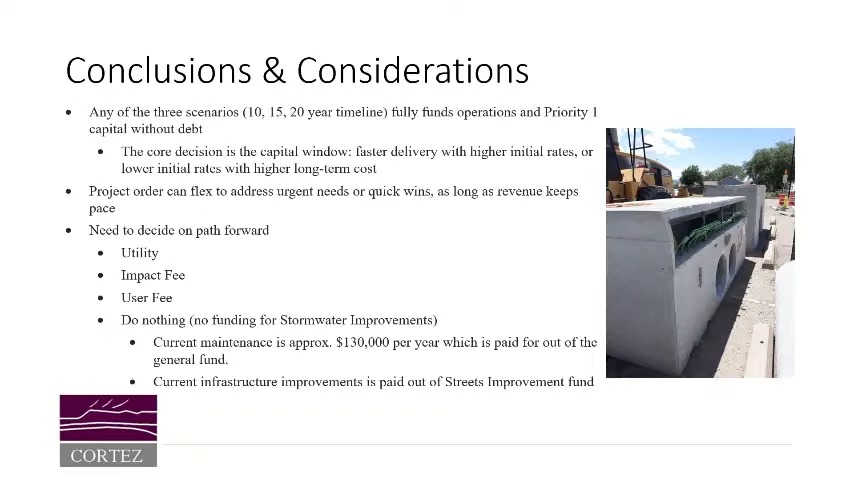
Cortez city staff will start working out how to set up a separate stormwater utility, with its own monthly fee, after council members said at a work session on Tuesday, November 10, that it was the fairest way to pay for years of drainage repairs the city has no money set aside for.
No vote was taken; a work session cannot take one. But when the table was asked whether anyone disagreed with pursuing an enterprise fund, no one did, and Public Works and General Services Director Casey Simpson said he would bring the city’s stormwater master plan back to council for adoption and work out a timeline with the finance director and city attorney.
The council’s regular meeting followed the work session and took the first vote on the 2027 city budget. That meeting’s video had no captions yet on Tuesday night; the Cortez Current will report it separately.
The stormwater plan
Simpson and project engineer Ian Roberson presented the stormwater master plan and a utility rate study, the second time council has seen them; they were first presented last year and have not been adopted.
The city’s consultant, Jones & DeMille, catalogued the city’s storm drain inlets, pipes, culverts and channels — now on the city’s mapping system — modeled how water moves through town, and ranked the problems it found from priority 1, a project that protects three or more homes or businesses, down to priority 4, a known deficiency with no current need to fix it.
Doing every project in 10 years would cost about $12.4 million at 2026 prices, or $14.1 million with inflation, about $1 million to $1.8 million a year, according to the presentation. Simpson said those numbers date from the end of 2025 and the start of 2026 and will need updating.
Today the city has no stormwater revenue at all, he said. It spends about $130,000 a year keeping the existing system working, out of the general fund through the streets department, and pays for stormwater construction out of the street improvement fund, where it competes with paving. “What doesn’t work honestly is we can’t continue to do storm water projects out of street improvement and fix the roads,” he said. “There’s just not enough money.”
He said three storms since the study was done would once have been called 100-year events, and that in the last two weeks alone he had toured four or five properties whose owners have flooding problems and want the city to do something.
Four ways to pay
The presentation laid out four options:
- A stormwater utility, run as an enterprise fund like the water fund, with its own fee. Simpson called it the strongest option for the long run but the most work to set up, and a new cost residents would have to accept. Its fee would be based on a property’s impervious area — roofs and pavement — so a big parking lot pays more than a house.
- A stormwater charge on water bills. The fastest to start, Simpson said, but it misses properties without a water tap, muddles the water fund’s accounting, and makes it hard to charge by impervious area.
- Impact fees on new construction. They would not fix existing problems, he said, and at the city’s historic growth rate would pay for none of the listed projects.
- Doing nothing, which leaves stormwater on the general and street funds.
The rate study modeled a monthly charge for a single-family home of about $13.75 if the priority-1 projects are done over 10 years, about $10 over 15 years and about $8 over 20 years, or $165, $120 and $96 a year. Industrial properties would pay about $151, $110 and $88 a month on the same schedules. A faster schedule costs more each month but less overall: about $13.3 million over 10 years against $17.8 million over 20, according to the presentation.
One council member asked whether such a fee would count as a tax under TABOR, the state’s Taxpayer’s Bill of Rights. Finance Director Randy Bailey said a utility set up as an enterprise is self-supporting from its fees and limited to what they bring in, while a fund kept on the government side could raise TABOR questions and need voter approval. An enterprise can still apply for grants, he said.
Mayor Pro Tem Bill Lewis said a utility charging by impervious area was the most equitable choice and the water-bill option the least fair, because only properties with a water tap would pay. Mayor Dennis Spruell and another council member agreed. Asked whether the 20-year schedule’s lower rate would cover the city’s needs, Simpson said yes, “but at half the pace of the 10-year plan,” starting with the most visible and costly problems. The choice of a 10-, 15- or 20-year schedule was left for later, when updated numbers are in.
Spruell credited city crews with keeping Cortez in better shape than its neighbors in the recent flooding.
The pool is back in the budget, on a shorter season
Asked how the proposed 2027 budget had been changed to pay for the outdoor pool — which the city found it had to keep open under a 2010 state grant agreement — city staff said the pool’s season was shortened “by a modest amount,” its staffing cut “by a fairly significant amount” and its supplies trimmed, while the capital improvements the pool needs were left in.
That put back roughly $300,000 to $350,000 in costs, staff said, cautioning against quoting the exact figure. To avoid drawing more from reserves, the city trimmed its technology budget, spreading the cut across departments, and put off replacing the Welcome Center roof. Net, staff said, the budget now draws about $15,000 less from general fund reserves than the version before the pool went back in.
Showers for Mancos residents
City Manager Drew Sanders said the Town of Mancos asked Cortez to let its residents shower at the Cortez Recreation Center during the town’s boil-water advisory, and the city is offering it at no cost.
Parks and Recreation Director Creighton Wright said the only requirement is proof of a Mancos address. The center is keeping a list of who uses it, and people should bring their own soap, toiletries and towels, which the center does not normally supply. The Mancos advisory is still in force.
Sanders said Cortez public works crews were also mobilized to help Pagosa Springs after its flooding, but Pagosa’s manager told the city on Sunday evening that the town had the resources it needed.
The municipal court
Municipal Judge Beth Padilla updated council on the court’s work. From January 1 to November 9, she said, the court has seen almost exactly as many criminal citations as last year — 446 against 448 — but juvenile cases rose from 20 to 34 after the city changed its ordinance to let more cases, such as underage possession of alcohol or THC at school, be filed in municipal court instead of district court. Parking cases fell from 134 to 14, which she said accounts for most of the drop in total cases.
She said her outreach court, started in August 2023 for defendants struggling with addiction, mental health or housing, has had 90 entries, and runs without city money by connecting people with local agencies. The teen court started this year now has 11 trained teen volunteers who act as judge, lawyers and jury for young people who admit what they did; the next volunteer training is December 11 at 9 a.m. She said she now accepts volunteers as young as 10, because Colorado can prosecute 10-year-olds. The court is also working through a backlog of old case files that a new state law requires it to seal.
Asked whether the city recovers jail costs, Padilla said she must assess court fees by statute but that people who cannot pay rarely do. Most jail time in her court, she said, follows an arrest on a bench warrant for missing court and ends in a plea for time served.
Closed session on the fiber line
Council also went into executive session to discuss negotiations over the Fiber Express Line, under the state law that allows a closed session to set negotiating positions. Lewis moved it and Councilmember Carly Wolf seconded; the six members present voted yes. When council came back into open session at 7:26 p.m., Spruell said no formal action had been taken. Spruell, Lewis and council members April Randle, Kathleen Swope, Wolf and Claire West took part, with City Attorney Patrick Coleman and Sanders.
Sources: City of Cortez work session and special meeting video, November 10, 2026 (YouTube); work session agenda. The agenda packet carried no stormwater documents, so the stormwater figures are from the presentation as given at the meeting.