County to weigh flood declaration to speed Road M repair
Road and Bridge told commissioners on Monday that Road M will stay shut until an engineer designs a fix, and that the county's bridges have not been inspected since the flood. The board asked for a disaster declaration to be ready for Tuesday's meeting.
Montezuma County is moving to declare a flood disaster, and the reason is a single road.
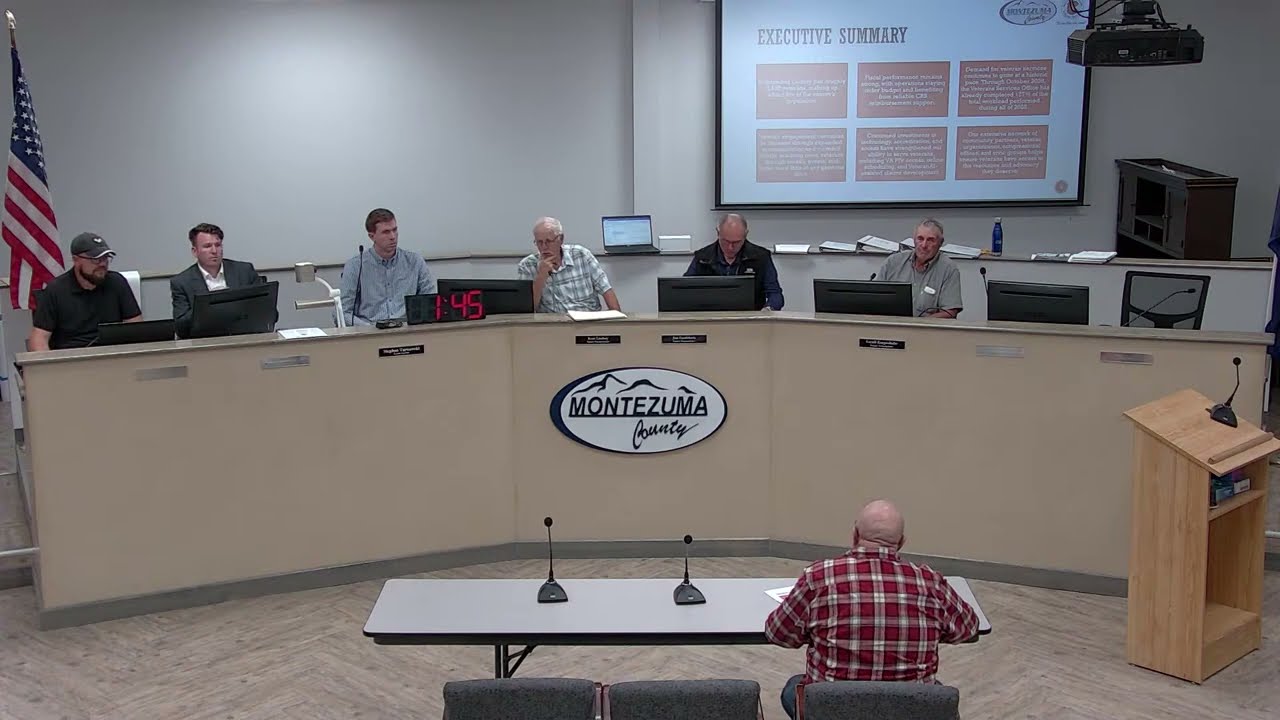
At Monday afternoon’s workshop, the county’s Road and Bridge department told commissioners that Road M will stay closed until an engineer has designed a fix for the drainage crossing that washed out under it, and that the engineers who would normally do that work are busy with the far worse damage in La Plata and Archuleta counties.
Rather than run a request for proposals and wait, the board asked County Attorney Stephen Tarnowski and County Administrator Michael Rime to have a disaster declaration ready for its regular meeting on Tuesday. A declaration would let the county use emergency procurement and hire an engineer directly.
“We need to get an engineer on board and the quicker the better,” Road and Bridge told the board, warning that going out for proposals first would leave the road “closed forever.”
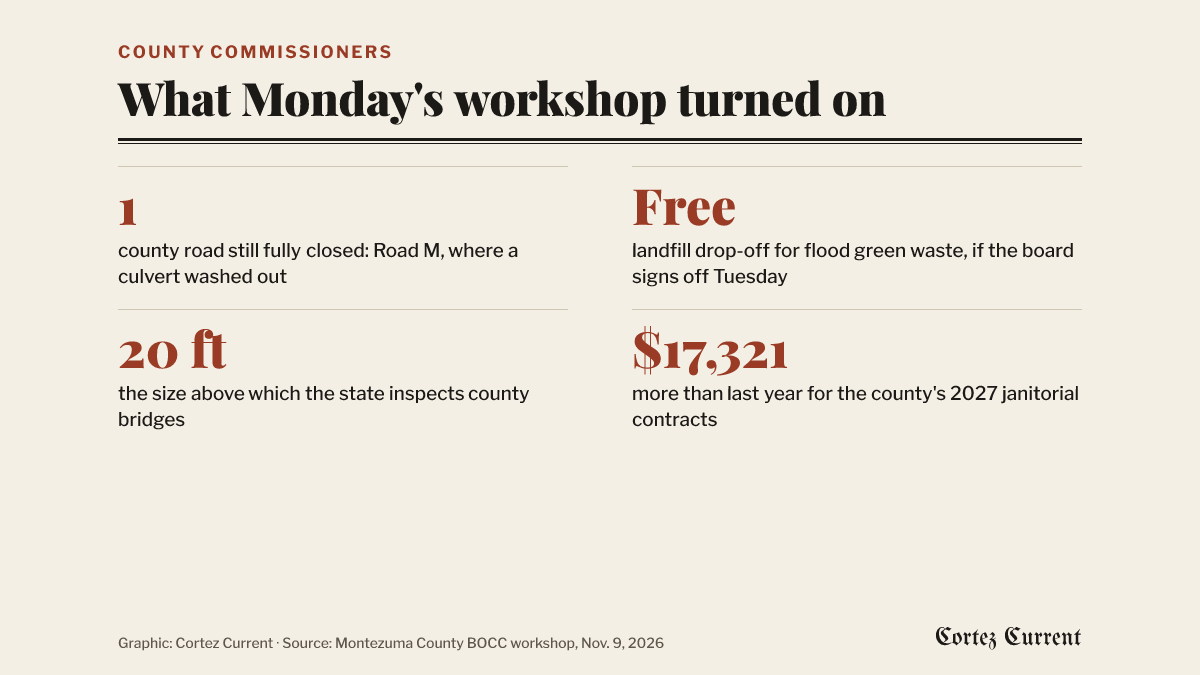
Graphic: Cortez Current. Source: Montezuma County Board of County Commissioners workshop, November 9, 2026
Road M
Road M is the only county road still completely shut, the department said. The county’s own written notice, posted to its Facebook page on Monday afternoon, puts the closure between Road 25 and Road 25.4; the Current reported that notice on Monday. At the workshop the department described the damage as a lost culvert at the Hartman drainage that took three-quarters of the road with it, and said barricades, signs and concrete barriers are now in place because drivers had been going around the closure.
The board was told the department does not want a quick patch. Commissioners and staff referred back to a culvert on another county road that was fixed in a hurry a few years ago and is a problem again; one commissioner said he did not want the same thing to happen on Road M in three or four years.
Road M carries a lot of traffic. “It’s a major thoroughfare for us,” one commissioner said, and staff said it has been near the top of the county’s traffic counts.
The rest of the county came through better than its neighbors, the department said. Several roads were closed in the first days after the flood and some were still down to one lane on Monday; Road K.3, which the county closed on November 1 where it leaves Highway 491, was being finished and was expected to be fully open within a day. Work was still going on in several other parts of the county.
The bridges have not been looked at
The part of the report with the longest tail was the bridges.
The state is due to inspect every county bridge over 20 feet, the department said, at some point between the fifth and the fifteenth of the month — but the river has been too high for anyone to see what is under the structures, and once the inspections happen it will take several months for the findings to come back. One structure has had a wing wall pulled away from its abutment, the department said; the road over it is still open, with cones around a place where the shoulder sloughed.
Structures shorter than 20 feet are not inspected by the state at all. Because of that, Road and Bridge said, it has taken heavy trucks off one county road north of Highway 184 and routed them around on another road with no bridges on it, and will leave them there until the smaller structures can be checked. “I think as far as public safety goes, we’ve sent them down the right road,” one commissioner said.
The department said the inspectors who usually handle those off-system structures are not available right now because of the flooding across the region.
A disaster declaration would help there too, staff said: nobody yet knows what the bridges will need.
Free green waste, and receipts for FEMA
Commissioners agreed to waive the landfill’s fee for green waste brought in after the flood, and said they would put it on Tuesday’s agenda for a formal vote.
That covers straight wood waste — branches and logs, the landfill said, and no treated lumber. The county ran the same free drop-off through the summer while the burn ban was on, and the landfill told the board it would not be a significant cost.
Other flood debris is still being charged for. The landfill has set up a separate code for it and records each customer’s address, so people can take their receipts and file for reimbursement through the Federal Emergency Management Agency, and so the county can produce a tonnage report later. So far, the landfill said, less than two percent of its customers have come in with flood material, and nothing on the scale seen to the east. The county’s code applies to Montezuma County residents; material hauled over from other counties is charged as ordinary trash.
The landfill also told the board it has had a letter from the Colorado Department of Public Health and Environment offering a waiver to accept friable and non-friable asbestos, and that it has replied that residents should keep taking it to the local permitted contractor they have used for years.
Separately, the department said the Town of Mancos is stockpiling green waste pulled out of the river and from under its bridges so it can haul full loads to the landfill rather than quarter-loads.
What goes to a vote on Tuesday
Several items were lined up for the regular meeting:
- Janitorial contracts for 2027. Bids were opened on October 28 after a walkthrough on October 12, with two bidders new to the county. Staff’s recommended low bids come to $17,321 more than last year.
- Two change orders on the Road 25 and Highway 184 project — a culvert at $18,948.32 and an asphalt apron where Road 279 meets Road 25 at about $19,035 for 81 tons. Both are above the amount a department head can sign.
- A lease for the McElmo gravel pit with Carol Tibbits, the yearly agreement the county has had for the stockpile ground there. The county attorney asked for a clause making future years contingent on a future board appropriating the money, so the lease goes back for redrafting before it returns.
- A pavement assessment from Jones and DeMille Engineering. Accepting the report closes out the grant that paid for it. Staff were careful to say the work was done before the flood; the Current reported the study’s main finding, that the county’s paved roads need about $38 million of work, in October.
A request from Trout Unlimited for a letter of support was also before the board. The group is applying for a restoration grant covering national forest ground and land at the base of Roaring Forks, an area named as a priority in a readiness plan for the upper Dolores watershed. The work would aim to improve stream flow and floodplain function, which may reduce the severity of flooding, erosion and debris flows after a wildfire, and would include in-stream habitat improvement.
A discussion of the Albertsons opioid settlement was put off. Neither the county attorney nor the board had notice it was coming, and it was moved to next Monday’s workshop.
Department reports
Veterans services. Travis Parker told the board his office has done 127 percent of last year’s volume through the end of October, with healthcare enrollments at 135 percent, claim submissions at 175 percent and appointments at 129 percent. About $7.2 million in federal money came into the county through the office through October, against a figure he said the Department of Veterans Affairs puts at roughly $18 million countywide — “a lot of room for growth.” The office has spent about 74 percent of its budget and has been reimbursed $25,477 by the state. A $15,000 state veterans assistance grant had gone to 54 local veterans by the end of October, $4,650 of it in food and gas cards, all reimbursed; he expects to spend the grant out by March. He also told the board that Rick Torres, who works in the office part-time, has been named veteran service officer of the year by the state association of county veteran service officers.
Parker said the office counts about 2,400 veterans in the county and thinks the census figure is low, and that it has seen 29 homeless veterans so far this year against 32 in all of last year.
He reminded the board of Wednesday’s Veterans Day events: a breakfast at the American Legion at 8 a.m., and the county’s parade, which starts at 1 p.m. and finishes at American Legion Post 75.
District attorney. Clarissa Osborn, of the 22nd Judicial District Attorney’s office, told the board that filings are a little below last year overall but high in two categories, crimes against children and felony drug cases, and that the office has had more complex felony cases this year. The office has won a grant that fully funds a pre-trial services position it has been required to provide for several years without money attached, with no local match, and expects the program to start at the beginning of the year. Asked whether the state’s new fentanyl law would add to its caseload, she said it probably would, called it an unfunded mandate, and said the pressure would fall more on law enforcement and the jails than on prosecutors.
Treasurer. Ellen Black told the board this year’s tax sale drew less participation than usual, which she put down to changes in state law and to higher tax bills, and that the figures were still being finalized. County investments are earning around four percent, she said, with most of the money in the state’s ColoTrust pool because it is the easiest to move in and out of. She plans to bring the board an updated investment policy in the next month or so.
Extension and 4-H. The extension office reported its highest number of members sent to the state fair in years, with every species represented except rabbits, and about 240 4-H members signed up last year — a number it expects to be a little lower this year, in line with what other youth programs are seeing. The office also runs a monthly newsletter and has been doing food preservation programming.
The landfill’s methane. Asked where the county stands on a methane collection system, the landfill said the site produces too little gas to run a flare and will be in a monitoring phase for years — walking a 25-foot grid for a year, moving to 100-foot spacing if nothing trips the limit — with compliance required by 2029. A state grant the county was encouraged to apply for only covers installing or upgrading collection systems, it said, so the county is unlikely to qualify. In the meantime the landfill plans to put another foot of soil over the site to hold the gas down.
The recording
The workshop ran about 65 minutes and is on the county’s YouTube channel; the agenda is in the video’s description. Figures and road designations given aloud at the workshop are reported here as what county staff said, not as published county figures. The Current does not print names it has heard only in automatic captioning, so some speakers are described by their department.
The board’s regular meeting follows on Tuesday; the county posts its agendas and recordings at montezumacounty.gov.
Update, November 11, 2026: the commissioners adopted the declaration as Resolution No. 13, Series 2026, at their regular meeting on Nov. 10, and were told the Town of Mancos could not be reimbursed by FEMA without it. Read the follow-up: County declares a flood disaster, opening the FEMA door for Mancos.