County told its paved roads need $38 million of work over 10 years
A pavement assessment presented to Montezuma County commissioners Tuesday put the cost of bringing every county-maintained paved road up to standard at about $38 million in today's dollars. The board took no action on the study, but approved a jail medical contract and a road equipment list.
Bringing all of Montezuma County’s paved roads up to the standard they should be at would cost about $38 million over the next 10 years, a pavement assessment presented to county commissioners on Tuesday found — a figure one commissioner said shocked him.
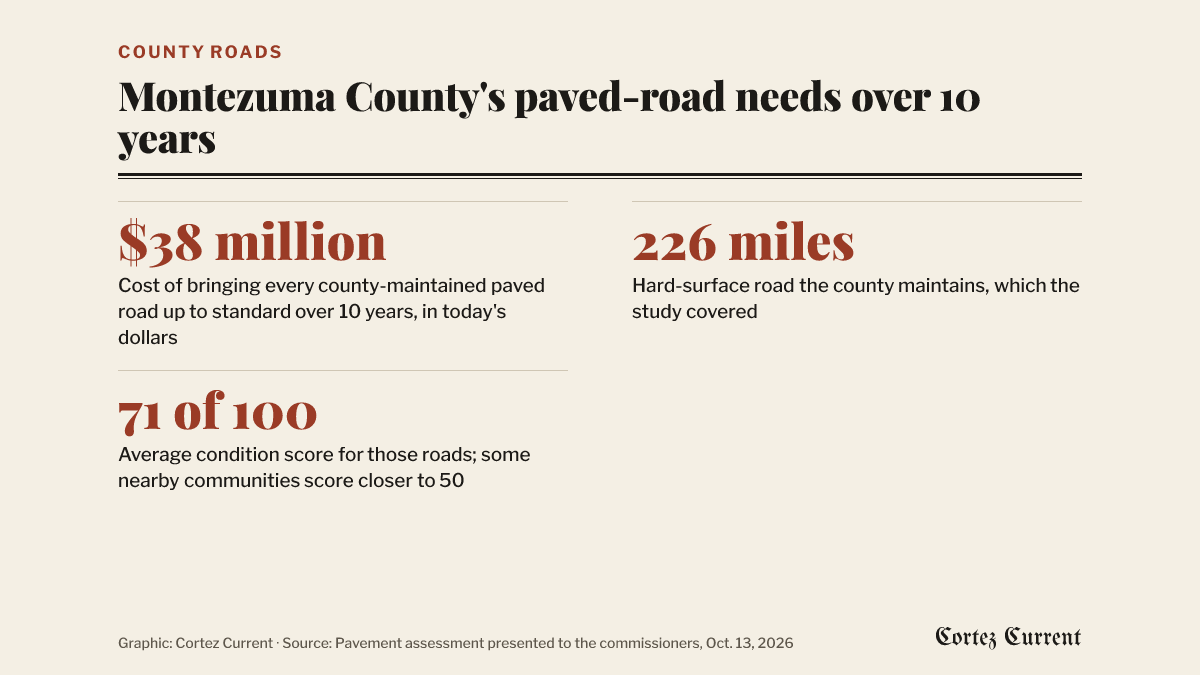 Graphic: Cortez Current. Source: pavement assessment presented to the Montezuma County commissioners, October 13, 2026
The estimate covers a little over 226 miles of hard-surface road that the county maintains. It is in today’s dollars and does not account for inflation. It does not cover the county’s gravel roads, and it does not cover the culverts, bridges, signs or other structures that go with a road — costs the presentation said would be added on top.
The county’s agenda for the meeting lists Heath Higgins, Tyg Bradshaw and Ty Koppenhafer as presenting the road study. The agenda gives no titles, and the recording does not identify each speaker reliably, so the findings here are attributed to the presentation rather than to an individual.
How the roads were graded
The assessment was done with software the county began using in July, under a program the board approved earlier in the year. The county received a 50% match toward the cost, so it paid half.
Rather than sending someone out to walk each road and measure cracks, the system mounts a camera on the front of a pickup that photographs the road every 10 feet. Image-analysis software then picks out longitudinal and lateral cracking, potholes and the alligator-pattern cracking that signals a soft base, and assigns each stretch a composite score from 0 to 100, where 100 is best. Staff said they drive roads they already know to be good or bad as a quality check against what the software reports.
Montezuma County’s paved roads averaged 71. The presentation said that is very good for a community of this kind, and that some others in the area score closer to 50.
The software also logs assets as it goes — signs, with notes on whether each is dirty, faded or hidden; manholes and storm drains; and potholes. Staff can photograph a problem in the field on a phone, have it tagged with a GPS location and assign it as a work order.
Culverts came up repeatedly. Staff said the county had no record of where its culverts were put in or when, that crews keep finding culverts nobody knew about, and that some have deteriorated until there is no culvert left at all. One commissioner asked whether the system would have caught the collapse on County Road M earlier this year. He was told probably not.
Staff said the county has cleaned a large number of culverts in the past seven months and expects to keep looking for them for another year.
What the plan would do
The presentation grouped work by priority over 10 years, using chip seals, two-inch overlays with a chip seal on top, mill-and-fill and full-depth reclamation, depending on the road.
Its central point was that maintaining roads already in good condition is far cheaper than rebuilding ones that have failed — about 20 times cheaper than pulverizing a road and reclaiming it to full depth. A chip seal lasts about eight to 10 years, and pushing that out builds a backlog that costs more later. The recommendation was to keep the good roads good and phase in replacements as the budget allows.
Staff said the next step is to package projects together and look for grants, including money that would pay for culverts before a road is chip sealed.
No vote was taken. One commissioner said the county had no real plan before this and that the study at least identifies the worst roads and which ones can still be saved.
The study covers only roads the county maintains. It does not include city or town streets, or Forest Service roads.
What the board decided
The commissioners renewed the medical contract for the county detention center with Southern Health Partners for 2027. Sheriff Steve Nowlin told the board the cost rises by roughly $900 a month, and said the provider has been a benefit, has kept staffing up as the contract requires, and has allowed the jail to identify medical conditions in people being booked in sooner. He said the average daily jail population has been 57 since January, against a contract limit of 80, which has not changed. Commissioners said costs are rising across the board and that the change was a small percentage. The motion passed unanimously.
The board also approved letting the road and bridge department seek estimates and bids on its priority equipment list: two tandem-axle trucks combining a dump bed, sander and snowplow, one tractor-mower attachment, and one water truck and tank. Staff said combining a snowplow and a dump truck into one machine should cut maintenance, because a plow can sit unused for nine months and the tandem trucks sit through winter. The board had already approved up to $200,000 from earlier auction proceeds for equipment purchases.
A list of equipment for public auction was approved unanimously as well. It includes a 1995 Kenworth T600B dump truck and a 1982 International four-wheel-drive snowplow — the two machines the combination trucks would replace — along with in-bed sanders and four rollers. Staff said the rollers sit more than they are used and need work every time they are pulled out for a project that lasts two or three weeks, so the department would rather auction them and rent when needed. The sale will be run through Purple Wave and is open to anyone to bid. Commissioners asked to be told when it goes live so the public can be notified.
The board approved the record of proceedings for its October 6 meeting.
Land use resolution held over
An item on a land use planning process resolution was pulled from the agenda and moved to next week, because Planning Director Don Haley was not present and had not reviewed changes made since the board discussed it the week before.
Three county residents spoke about the draft during public comment. The Cortez Current does not name members of the public who speak on their own behalf.
One said the draft’s requirement that all documents be submitted seven days before the public hearing does not say which hearing that means — the Planning and Zoning Commission’s or the commissioners’ — and asked whether there is a second window after Planning and Zoning. He said he had no objection to a seven-day cutoff but asked for the right to hand commissioners documents during public comment, provided they had already been uploaded to the county’s portal, arguing that without being able to show a map, a photo or a highlighted statute, a commenter cannot tie what he is saying to anything on the record.
A second asked how residents can know when submitted material has actually been read, and whether letters and comments delivered by hand or by mail would be excluded. She noted that not all county residents have internet access.
A third said he is a senior citizen with no internet at home and on a fixed income, and that using the portal would mean going to the library or finding a friend with a connection. He asked the commissioners to consider the effect on older residents.
County Attorney Stephen Tarnowski said afterward that the point about the public being able to use documents during comment was a good one and could be made explicit, but that there is an asymmetry the board has to respect: accepting written material during a quasi-judicial hearing that the applicant has had no chance to inspect and answer is a due-process problem. He said the draft carves out a good-cause exception for an applicant — for a study finished late, for example — and that he did not think the same could be done for the public, while the aim of the seven-day portal process is to give the public a more meaningful way to put written material in front of the board than it has now.
The chairman said the resolution would go back on Monday’s workshop so Haley can take part before it returns to a Tuesday agenda.
Other business
Tarnowski said the court ruled for the county and the Colorado Department of Public Health and Environment on amending the address in the stipulated injunction order that requires the operators of the Ironwood site to remove waste from the facility, which the Cortez Current reported on October 9. He said the defendants have filed a motion to continue the separate contempt hearing, the county has objected, and the court has yet to rule; as things stand the hearing is set for all day Friday in courtroom 4. He added that a contempt finding would not resolve what happens at the site, that conversations with the defendants’ attorneys are continuing, and that there is no agreement sketched out.
Tarnowski also gave a verbal summary of a draft short-term rental ordinance for the unincorporated county, which he said the planning department wants finished by the end of the year because of a grant tied to it. It would cover stays of less than 30 days for compensation that are not hotels, and would distinguish rentals inside structures from ones that are not, such as RVs or campground-style sites. He said the draft would require correct addressing and driveway and septic permits, information for guests about the burn ban, noise and quiet hours, parking off county roads, a local contact person for each operation, and proof of enrolment in the lodging tax program. It would set two compliance routes: a three-strike process with the planning department for minor matters such as parking or noise complaints, and a separate path under which the department could revoke a licence.
The county’s finance presentation on the proposed 2027 budget is covered in a separate story.
The clerk and recorder’s office told the board every mail ballot has gone out, that some voters had not received theirs yet and should be patient, and that anyone with a problem can get help once the senior center building opens on Monday. Staff added that voters can check their registration through the Secretary of State.
The commissioners held no executive session.
The meeting is on the county’s website, which also carries the agenda, and the recording is on YouTube.