County declares a flood disaster, opening the FEMA door for Mancos
Montezuma County commissioners adopted Resolution 13 on Tuesday, declaring a local disaster emergency over the October and November flooding. Without it, the Town of Mancos would not be eligible for FEMA reimbursement. The board also made green waste free at the landfill through the end of the year.
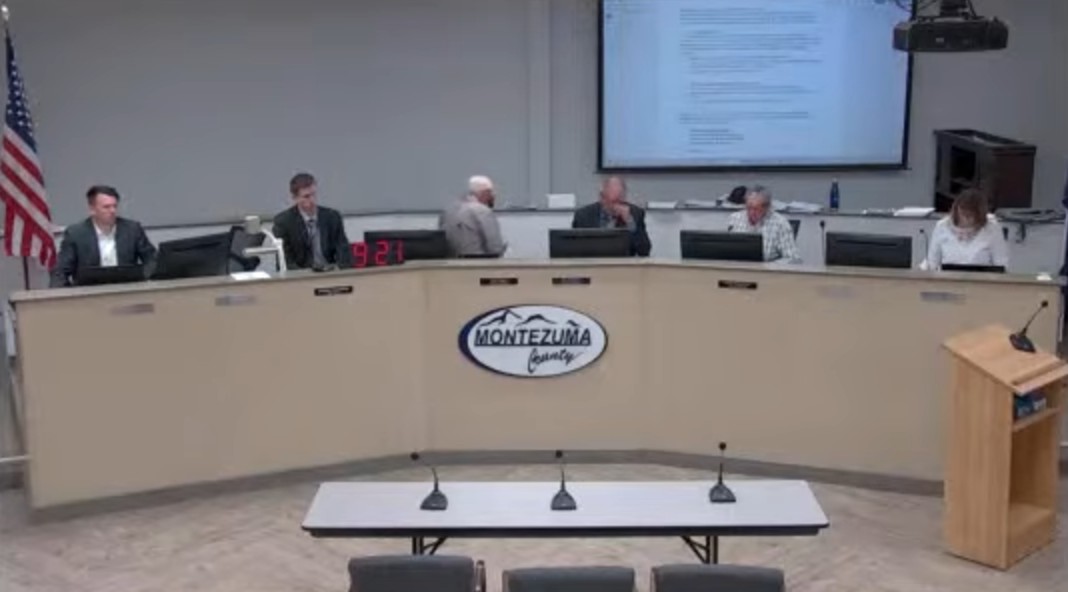
Montezuma County commissioners declared a local disaster emergency on Tuesday morning over the flooding that has run through the county since late October, a step the board was told the Town of Mancos needs before it can be reimbursed by the Federal Emergency Management Agency for anything it has spent.
The board adopted Resolution No. 13, Series 2026, unanimously. It was not on the published agenda: the chairman added it at the start of the meeting as a fourth item needing individual consideration, after the county attorney and the county administrator were asked at Monday’s workshop to draft one. The Current reported on Monday that the board was weighing the declaration.
What the declaration says
County Attorney Stephen Tarnowski read the resolution into the record before the vote. Its findings recite that the county “experienced persistent heavy rain events and flooding beginning on October 23rd, 2026, resulting in soil saturation and widespread flooding and damage to personal and public property, including critical infrastructure,” and that Gov. Jared Polis declared a verbal local disaster emergency that same day for 12 affected counties, Montezuma among them.
A second storm beginning Nov. 1, it says, “caused additional damage throughout Montezuma County, particularly in the towns of Mancos and Dolores as a result of water levels in the Mancos and Dolores rivers exceeding the 100-year flood levels.” It records damage to county roads, bridges and drainage infrastructure “which are still being documented and evaluated by the county road and bridge department,” and it names the three things that went wrong with water around Mancos: flood water overtopping the municipal wastewater treatment lagoons, sediment limiting the municipal drinking water treatment plant, and a separate mainline failure for Mancos Rural Water customers.
The resolution’s closing finding is the one that matters for money: “local emergency resources have reached their capacity and broader disaster response assistance is required.”
The operative part does six things. It declares the emergency; activates the response and recovery parts of local and interjurisdictional emergency operations plans; authorizes the county’s Office of Emergency Management to coordinate response, seek mutual aid and work with local, state, tribal and federal agencies; authorizes the county administrator and the emergency management office to use emergency procurement procedures, with every such action documented for audit and open-records inspection; formally asks the governor, the Colorado Division of Homeland Security and Emergency Management and federal agencies for assistance; and directs the clerk and recorder to file the resolution. It takes effect immediately and stays in force until the board ends it or conditions no longer warrant it.
Why Mancos needed it
The board heard from the deputy director of the Region 9 Economic Development District, Shak Powers, who had been helping the county and the towns on recovery funding.
He told the commissioners he had been in contact with the state’s Department of Local Affairs, and that a state official there had advised that without the county’s declaration the Town of Mancos “would be ineligible for FEMA reimbursement” — even though, he said, the town was declaring its own disaster at its regular board meeting the following night. “This is an umbrella step that the county is taking to help protect the town of Mancos,” he said.
He was blunt about what it does and does not mean. If the governor requests a second FEMA disaster declaration, and if the president grants both, “money will still move at the speed of government and it’s on a reimbursement basis,” he said. Eligible expenses are reimbursable up to 75 percent if approved. “But without the disaster declaration, none of your expenses are eligible for reimbursement.”
He also told the board that Region 9 has activated a disaster assistance loan program for businesses hit by the flooding: loans of up to $10,000, interest-free for six months, with details on the district’s website at region9.org.
A commissioner said he had spoken the day before with a FEMA official working in the region, who had also recommended the declaration, and that it would cover all of Montezuma County. He cautioned that individual assistance from FEMA is unlikely to arrive for some time, and that entities such as the county and the towns of Cortez, Mancos and Dolores would see help first.
Mancos restaurants closed, rural water still off
In the discussion before the vote the commissioners gave the plainest public account yet of what the water emergency has done to business in Mancos.
The county reached out to public health on Tuesday morning, the chair said, and was told there were “absolutely no changes” to the boil-water situation. One commissioner said every food establishment in town is shut: “all the restaurants in Mancos are shut down. Everything that serves food basically is shut down because the water system’s under a boil order,” he said, adding that the health department had closed them until the order is cleared and that they had been closed since the previous Thursday.
The same commissioner, who is on Mancos Rural Water’s system himself, said most of that system is still off. He said he had water at his house for about 24 hours on Saturday and that it had been off for four days before that and was off again.
The Current has been following the Mancos water emergency in a running story. The town said in a notice at 8:30 p.m. on Tuesday that crews had repaired two water main breaks found that day, and that the boil and bottle advisory “remains in effect until the Town receives written authorization from the Colorado Department of Public Health and Environment (CDPHE) to lift it.”
Green waste free at the landfill through Dec. 31
The board also voted unanimously to waive the Montezuma County Landfill’s fee for green waste through the end of 2026, so that people clearing flood debris are not charged to get rid of it.
The chair raised it by analogy to the county’s practice during summer fire bans. A commissioner suggested a month; another said it should run longer because people in the worst-hit areas still cannot reach their property. The motion that passed runs to the end of the year.
The county posted its own notice at 12:50 p.m. the same day. “To assist residents with flood debris cleanup, Montezuma County Landfill will accept green waste at no charge through December 31, 2026,” it reads. “Residents cleaning up fallen trees, branches, brush, and other green waste from recent flooding are encouraged to take advantage of this service.”
Road M needs no separate vote
The washed-out stretch of Road M, closed since last week, was listed on the agenda as an item needing individual consideration. The chair moved it to sit with the declaration, and after the vote said the county now needs an engineering firm to design the repair, with the hope of getting the road back in service before the end of the year.
Asked whether the board needed to act separately, the county attorney said no: the emergency procurement procedures the declaration authorizes already cover it. “I think that’s already kind of built in in the context of the disaster declaration,” he said. The chair said the board could take further steps if a problem came up.
Public comment: eight speakers on solar
The longest part of the morning was public comment, and almost all of it was about one subject.
Eight of the nine people who spoke asked the board to reinstate the county’s moratorium on utility-scale solar projects, to apply it to all pending projects, and to repeal Chapter 10 of the land use code, the chapter that allows those projects. Several also asked the board to extend a moratorium to battery energy storage systems. Most read a near-identical statement.
Speakers referred to claims they said had been presented to the commissioners the previous day at the county’s monthly Coffee with the County session: that a petition drive which brought 355 signatures to the board in November 2025, while it was deciding whether to renew the solar moratorium, had been paid for by a developer, designed by a national public-relations firm and staffed by canvassers from a Denver company. One speaker said those firms had published case studies describing the campaign.
The Current has not verified any of those claims and is not reporting them as fact. They are what speakers told the board. One speaker also asked the commissioners to formally request the resignation of one of the three commissioners over his part in advancing Chapter 10, saying it was “not intended as a personal attack” and that the commissioner “may have been operating with incomplete or misleading information.” The Current is not naming the commissioner, because the allegation underlying the request is unverified and the board took no action on it.
The board did not respond to the solar requests during the meeting, took no vote on any of them, and did not put the subject on the agenda. Nothing before the commissioners on Tuesday concerned solar.
One other speaker, who said he is an engineer and had worked as a state engineer for the Natural Resources Conservation Service, used his three minutes on flood repairs. He praised the county’s road and bridge crews, warned that patch repairs using uncompacted fill and bridges without wing walls below grade would cause problems for years, and described a federal watershed-protection program that he said does not require a state or federal emergency declaration, carries a 70-30 cost share and has a 30-day application window from the disaster.
The rest of the meeting
Consent agenda, cut to two items. The board pulled the lease with a private owner for the McElmo gravel pit and the Albertsons opioid settlement, moving both to next Monday. What passed was a pavement assessment presented by Jones and DeMille Engineering and a letter of support for Trout Unlimited, presented at Monday’s workshop by the county’s natural resources director, James Dietrich.
Janitorial contracts for 2027. Seven companies bid. The board approved the buildings and grounds manager’s recommendations as presented, displayed on screen during the meeting.
A boundary adjustment near Mancos, approved after a hearing. The 9:30 a.m. public hearing was on a subdivision amendment to two lots on Road 39, east of Road 38.5 and south of Highway 184, outside Mancos. Planning Director Don Haley told the board it is “basically a boundary line adjustment” that has to go through a hearing because the lots sit in a platted subdivision of exemption. The owner of one lot is selling; the neighbor is buying just over six acres to the west to enlarge a grazing area, taking a parcel of about 10 acres to roughly 16 or 17. Both properties keep their residences, utilities and access. The county planning commission had recommended approval unanimously. Nobody spoke for or against, and the board approved it unanimously. The applicants are private individuals and are not named here.
Two change orders on the Highway 184 realignment. The board approved amendments two and three to the agreements for the Highway 184 and County Road 25 realignment project, one for rumble strips and one for extra asphalt paving from Road 25 onto Road 27. The chair read one figure as $18,948; the recording does not carry the other clearly, and no written copy was displayed, so the Current is not printing it.
Minutes. The board approved the proceedings of its Oct. 27 meeting and of special meetings held Nov. 2 and Nov. 5.
Turnout. Deputy Clerk Jerri Frizzell told the board that turnout in the general election came to about 63 percent of voters counted so far.
The county attorney’s report
Ironwood. The court denied Ironwood Group’s motion asking it to reconsider the order amending the stipulated injunction that requires the wood waste to be removed, Tarnowski said; the amendment had changed the address to better reflect where the waste sits. The county is “still moving forward toward our eventual contempt hearing,” he said, and the company could try to appeal on an emergency basis. Settlement conversations continue, he said, focused on what happens to the waste left on the site and on how that relates to Ironwood’s plans to return to production in some form.
Leaf Properties. The county’s brief to the Colorado Court of Appeals in the dollar store case is due a week from Friday. Leaf Properties is the appellant; the district court upheld the county’s denial of the permit in July.
Septic rules, and hearings vacated. Tarnowski told the board he had met with the health department about how the county applies Regulation 43, the state’s on-site wastewater treatment system rules, locally. The priority, he said, is to safeguard public health; alongside it, the county wants to work with residents who have difficulty meeting standard requirements or who have unusual living situations. There is more room for local control in the county’s own adoption of Regulation 43 than it has taken up, he said.
In the cases currently in front of the board, he said, there is not technical compliance with local rules, but “in each of those cases there wasn’t any threat to the public health,” by which he meant no evidence of wastewater discharge. On the health department’s recommendation, he asked the board to let him vacate those pending hearings so the situations can be considered under new local regulations the county intends to write, which the board of health would have to adopt.
Commissioners agreed. One said he did not think the current hearings would “get any movement in a positive direction just due to the circumstances of the people,” and that the approach might avoid taking housing away from anyone. “I don’t think any of us up here want to displace somebody,” he said. Another said the board had “beat this horse pretty hard.” Tarnowski said he would be clear that nothing would turn “a blind eye toward any actual” violation and that the existing rules still stand.
Background checks, and a new administrator
The chair asked the board to give staff direction on the county’s background-check policy, after an error in it came to light last week. The idea, as the county attorney described it, is to give the administrator discretion, depending on the nature of the job, to move a hire forward if a background check has not come back within 14 days — not an automatic override, because some county positions handle sensitive information, and not applying to social services. The board agreed and gave staff direction. No vote was taken.
Sitting on the bench for the first time in public was the county’s new administrator, Michael Rime, whom the chair introduced and who said it was his second day. He had nothing to report.
The chair also used his own report to correct something he had said at Monday’s Coffee with the County: he had told the public the county was earning about 2 percent on its largest pool of money, held in ColoTrust, and the county treasurer had since told him the rate is 4 percent.
He said he had been called by the governor’s office on Thursday night and met on Friday at the La Plata County airport with members of Colorado’s congressional delegation, who had been touring flood damage in La Plata and Archuleta counties by helicopter. Montezuma County, he said, “fared very well” by comparison, and he credited the road and bridge department’s culvert clearing over the summer.
Sources: Montezuma County, Board of County Commissioners regular meeting, Nov. 10, 2026, and the meeting recording on the county’s YouTube channel · Montezuma County, Board of County Commissioners agenda for Nov. 10, 2026 · Montezuma County, notice posted to its Facebook page at 12:50 p.m. Nov. 10, 2026 · Town of Mancos public service announcements, Nov. 10, 2026