RE-1 board puts off vote on appeal in transgender-sports lawsuit
The Montezuma-Cortez school board tabled the question until Nov. 17 on a 4-1 vote. It also hired a pay-study firm, approved a $77,000 school-lunch consultant and held off on an HVAC decision for three elementary schools.
The Montezuma-Cortez School District RE-1 board voted 4-1 on Oct. 20 to wait until its Nov. 17 meeting to decide whether the district stays in the appeal of a federal lawsuit over transgender students and school sports, putting the decision after the Nov. 3 election.
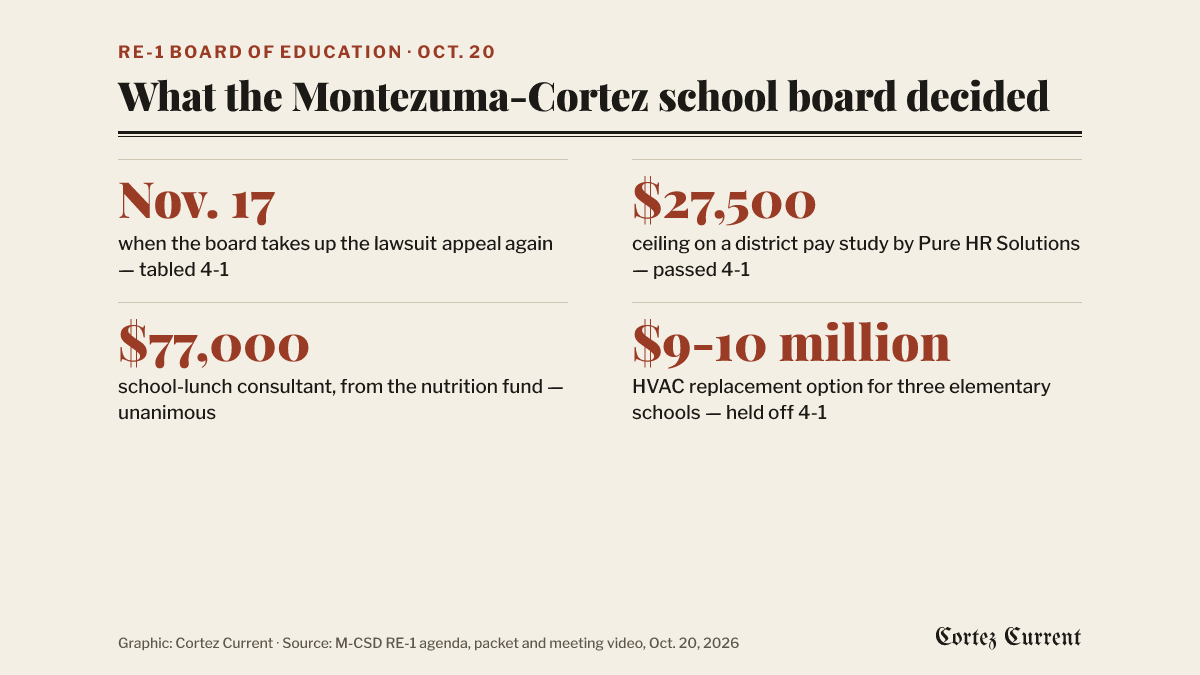 Graphic: Cortez Current. Source: M-CSD RE-1 agenda, packet and meeting video, October 20, 2026
The district is one of eight plaintiffs — school districts, charter schools and a BOCES, led by School District 49 near Colorado Springs — that sued the director and members of the Colorado Civil Rights Division and Attorney General Phil Weiser in 2025. They argued that the Colorado Anti-Discrimination Act and its regulations conflict with their policies classifying sports teams by biological sex and keeping locker rooms separated by sex.
Senior U.S. District Judge John L. Kane dismissed the case on Aug. 26, 2026, adopting a magistrate judge’s recommendation. He ruled that a school district, as a political subdivision, cannot sue its own state over rights under the Fourteenth Amendment, and that the plaintiffs lacked standing to bring the claims on behalf of their students. The plaintiffs’ appeal was docketed at the 10th U.S. Circuit Court of Appeals on Sept. 29 as case No. 26-1381. The judge’s order was attached to the board’s agenda.
Interim Superintendent Drew Pearson recommended on the agenda that the district continue with the appeal, and a motion was made to do that with the law firm First & Fourteenth, which represents the plaintiffs, as counsel. Before it came to a vote, one board member said the parties were waiting to see how ballot measures fare in the election — if they fail the case would need to go on, and if they pass there would be no need — and that no money would be spent on it between now and shortly after the election. The board then voted to table the motion until the Nov. 17 regular meeting.
Board President Joshua Shumway and Directors Laura DeWitt, Mike Lynch and Jason Hall voted to table it. Director Lara Maria Blair, who attended by video, voted no. Directors Barbara Mate and Justine Bayles were absent.
Proposition 134 on this year’s statewide ballot would require school sports teams, from elementary school through college, to be designated by biological sex. The Current’s explainer on Propositions 134 and 135 covers what each would do.
Pay study, school lunches and a water heater
The board hired Pure HR Solutions to study the district’s salary schedule for no more than $27,500, also by a 4-1 vote. Five firms answered the district’s request for proposals, with prices ranging from $10,800 for 15 positions to $77,400, according to the scoring sheet in the agenda packet. Pearson told the board the firm’s principal is a former Colorado school district administrator, that its study covers stipends, and that it leaves the district a workbook so the study can be repeated. Its 17-week timeline was the longest of the five, he said; a board member said that would bring results around February, in time to vote on a salary schedule in March.
The board voted unanimously to hire School Food & Wellness and Wellness in the Schools to help the district’s nutrition program with menu and recipe development, kitchen staff training, kitchen workflow and promotion this school year. The agenda summary puts the cost at $77,000 from the school nutrition fund. The money was not budgeted, but the summary says the fund has enough balance and that spending it will help bring that balance down to an allowable amount; district staff told the board the balance should not exceed three months of operating costs. Five proposals came in. Staff said the department has already been moving toward more scratch cooking and less frozen prepared food.
By 4-1, the board renewed its agreement with the Montezuma School to Farm Project for 2026-27, under which the district contributes $20,000 a year toward its school garden program. Pearson said the program was first quoted at $26,000 and the price came down when it determined it could not teach at Mesa Elementary. He said the district has approved it each of the past six years.
The board also voted unanimously to spend $11,000 from capital reserves on an emergency water heater replacement at Kemper Elementary. The request form says the old one had gone out completely and the school was running without hot water.
Cooling the elementary schools
By 4-1, the board took Pearson’s recommendation to take more time and review more options before deciding how to fix heating, ventilation and air conditioning at Kemper, Mesa and Lewis-Arriola elementary schools. His written report laid out three paths: a full design-build replacement estimated at $9 million to $10 million and potentially ready for next school year; repairs that would cost less but likely not be ready by then; and temporary measures, mostly with district crews, to get through what the report calls roughly four weeks of heat a year.
One board member, citing figures from the consultant, Performance Services, put the cost of a new elementary school at about $50 million and said spending close to $10 million on HVAC systems for the three older buildings would be irresponsible. Another said the district’s 2024 facilities report lists current code violations at the elementary schools. A third asked that the district revisit its extreme-temperature plan with public health guidance, saying classrooms in the mid-80s are not a good place to learn.
Pearson said the district needs a long-term goal for its buildings before making these decisions, noting that its last district-wide facilities master plan is, as he understood it, close to 20 years old. He said the outcome of the district’s pending HVAC litigation could widen its options, and that he would bring the HVAC question, the Manaugh building and facility planning to the Nov. 3 work session.
The Manaugh roof
The former Manaugh Elementary building, closed since 2022, has a roof that has leaked for several years, with water damage inside and possible mold, according to a maintenance report in the packet. The report puts a full roof replacement at $600,000, plus a rough $250,000 to remove asbestos from one section of the roof that tested positive. District maintenance staff told the board an insurance adjuster had inspected the roof that morning, and that a patch might get it through the winter but would last six months at most.
Pearson said a feasibility study of options for the building is waiting on approval from a historical society, because the building has a historic designation.
Policies and board roles
The board unanimously made permanent two policies it had adopted under its emergency process: DJ/DJA, on purchasing, and FEB-R, on construction procurement and management. It tabled two others. Justin Schmitt, the executive director of academic services, asked for time on IKF-E-1-2029, a graduation requirements policy. He said it has no capstone option for showing graduation competency, an option meant partly for special education students; that it recommends rather than requires coursework covering the Holocaust and genocide; and that it lists 25 required credits in one place and 26 in another. District staff said the bidding policy, DJE, requires posting bids on Bidnet, which the district has been unable to join. Both tabled policies must go through the adoption process again.
The board also heard first readings, with no vote, of an updated anti-harassment policy, GBAA, and Title IX procedure, AC-R-2, carrying edits from the district’s lawyers; a board member said the updates were needed because the law had changed.
By 4-1, it added three board liaison roles — to the student representative, to facilities and to the District Accountability Committee — alongside its existing assignments. Shumway filled them from volunteers, keeping Bayles as the board’s representative to San Juan BOCES.
From the reports
- Pearson’s written report says fall STAR testing found 14 of 19 grades starting the year below the national median in reading and 13 of 17 in math. Lewis-Arriola grades 2 through 5 were above the median in both.
- San Juan BOCES and the Southwest Colorado eSchool have asked to explore sharing costs and responsibilities for the district’s online program, the report says. Schmitt told the board that about 27 full-time online students in the middle and high school are new to the district this year.
- The board will hear from superintendent search firms at its Nov. 3 work session, according to that agenda, and Pearson’s report lists choosing a firm for Nov. 17. The Current’s preview of the work session has the rest of the agenda.
The meeting ran about two hours and 15 minutes and is posted on the district’s YouTube channel. The agenda and attachments are on the district’s Diligent Community portal; the meeting’s minutes have not yet been approved. Except on the tabling motion, the recording does not say who cast the no votes on the 4-1 items. The appeal’s case number and filing date are from the 10th Circuit docket. The Cortez Current does not name students.