Cortez council awards $44,050 comprehensive plan contract
A state law gives the city until December 31 to add strategic growth and water supply elements to its comprehensive plan. Council also designated a 1938 Main Street building as historic, canceled its December 22 meeting and approved a letter supporting a 70-unit affordable rental project.
The Cortez City Council voted unanimously on Tuesday to award a $44,050 contract for two new chapters of the city’s comprehensive plan, work the state requires the city to finish by the end of this year.
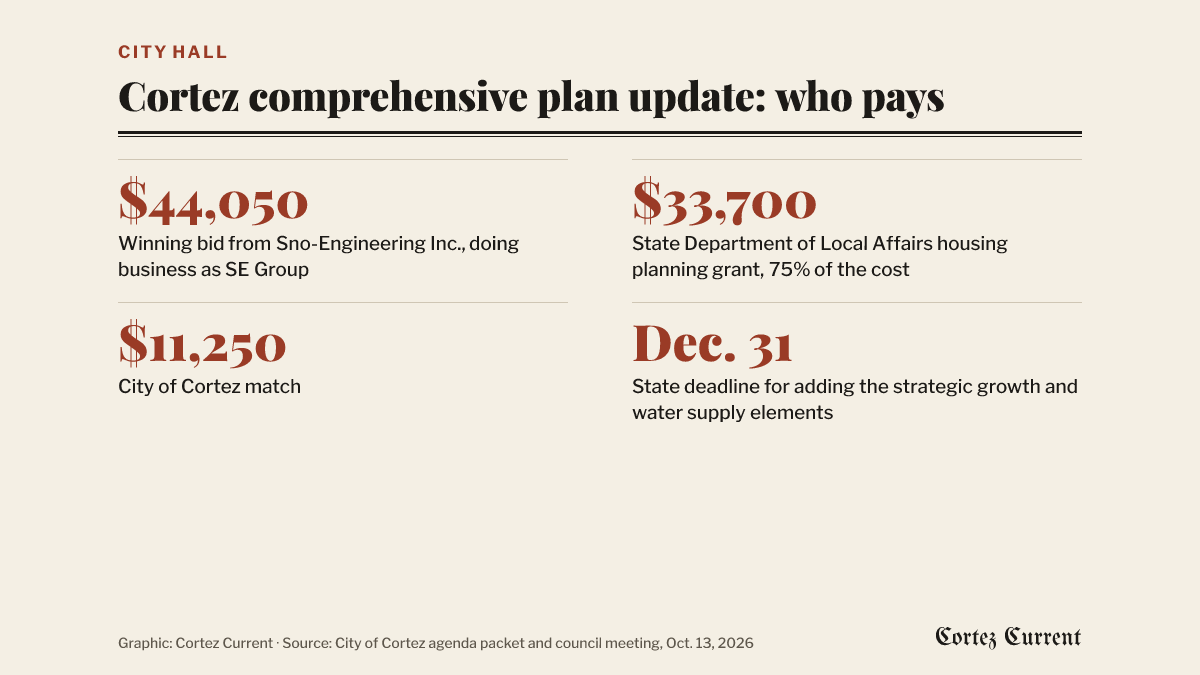 Graphic: Cortez Current. Source: City of Cortez agenda packet for October 13, 2026, and the council meeting recording
The council awarded the 2026 comprehensive plan update — a strategic growth element and a water supply element — to Sno-Engineering Inc., doing business as SE Group, at its bid price of $44,050, and authorized the city manager to negotiate and sign the contract. The Cortez Current set out what was on Tuesday’s agenda, including the four firms that bid, when the packet was posted.
Senate Bill 24-174, one of several housing, land use and water measures passed by the legislature in 2024, requires local governments to include both elements in their comprehensive plans by December 31, 2026, and to update them at least every five years after that.
Three-quarters of the cost is covered by a $33,700 housing planning grant from the state Department of Local Affairs, awarded on March 13, 2026, with a city match of $11,250 against a $45,000 project estimate, so the winning bid came in under the estimate.
What the packet did not say was how the firm was chosen. Jason Armstrong of the community and economic development department told the council a review committee of department staff, public works staff and a representative of the Planning and Zoning Commission had scored the bids and interviewed the top two in September, and that bid cost and the firm’s familiarity with local needs were the deciding factors in a competitive field. Councilmember Clarisa Osborn moved to accept the bid and Councilmember Kathleen Swope seconded; all seven members voted yes.
What the two new chapters have to do
The strategic growth element will analyze and help the city prioritize infill development while preserving open space and surrounding agricultural land — language Armstrong said comes straight from the legislation. He said the work would look at open parcels with the Planning and Zoning Commission and staff to decide which to prioritize, giving parcels nearest the downtown corridor as an example.
Asked whether water supply had not already been covered by the water system master plan the council adopted this year, Armstrong said there is a water supply chapter in that plan but the legislation has requirements it does not meet. He said he had compared the master plan against the scoring rubric the state will use, and listed the gaps: no standing coordination structure with water providers; a water conservation policy framework that references the city’s 2018 water conservation plan and 2023 drought management plan without translating them into comprehensive plan policy; infill treated as a demand input rather than a conservation strategy; no link between development approval and water supply adequacy; and no quantified conservation targets tied to the demand forecast.
On the first, he said the state is recommending a water and land use planning integration team — planning and water utility staff reviewing projects and sharing data together on an ongoing basis. On the fourth, he said the state’s guidance points to the “assured water supply” or “show me the water” approaches other Colorado municipalities use, which weigh a proposed development’s water demand against available supply before approval and attach conservation conditions through zoning or a planned unit development. On the last, he said other communities have set explicit numeric targets, such as a stated percentage reduction in consumption per person by a target year, which would give the five-year reviews something to measure against.
One council member asked why this was the right time to spend the money, given the city’s budget. Armstrong said it is required by the end of the calendar year, and that 75% is already paid by the state with the match budgeted in the current fiscal year. Another council member asked whether “unfunded mandate” was the phrase; Armstrong said it would be, without the grant.
Armstrong said the two chapters are meant as an interim set that will fold into a new comprehensive planning process the city expects to begin in 2027. He thanked the public works director and his team for helping write the request for proposals so the scope would address the gaps rather than duplicate the master plan.
A 1938 building joins the city register
On second reading, the council unanimously approved Ordinance 1377, Series 2026, designating the building at 209 West Main Street as a historic resource and adding it to the city register of historic resources. Councilmember Bill Lewis moved and Councilmember Carly Wolf seconded. No one spoke at the public hearing.
The building, now occupied by Fundamental Needs, was built in 1938 and has housed Pennington’s Samstown furniture and, more recently, the Renew Center. The Historic Preservation Board voted unanimously to recommend it, finding its cultural significance in its part in the commercial development of downtown Cortez since 1938.
Staff described its character-defining features as its one-story horizontal massing and overall flat form, in line with the international style; the craftsmanship of its brickwork; and its projecting straight and slanted fins. A wood-shingled angled hood over the front was added in a 1969 remodel and has since been updated. The designation makes it the 20th commercial building on the city register.
After the vote, council members asked whether future designations could be handled by resolution rather than ordinance. The city attorney said he is drafting an ordinance to amend the code to allow that, which would itself need a first and second reading, and that he hoped to bring it to the next meeting.
Food vendors, housing and the holidays
The council approved on first reading Ordinance 1371, Series 2026, revising the part of the city code that governs annual licensing for mobile food vendors, and set the public hearing and second reading for October 27, 2026. Community and Economic Development Director Rachael Marchbanks said the ordinance has been long in the making and is meant to simplify and streamline permitting for vendors who are already allowed to operate in the city. Asked about application fees, she said staff are not recommending one at present.
Council authorized Mayor Dennis Spruell to sign the Colorado Housing and Finance Authority’s notification to local jurisdictions form for Park Village on 7th, a proposed 70-unit affordable rental development on city-owned land at the former high school property. Marchbanks said the developer, Evergreen, which the city is partnering with, had asked for the city’s comments on whether the project supports the city’s goals. The motion passed unanimously.
The council voted unanimously to cancel its regular meeting scheduled for December 22, because the fourth Tuesday falls in the same week as Christmas. City Clerk Danielle Wells said council has historically canceled that meeting and staff brought it forward so the city and the public could plan. Council members said a great deal of work goes into each meeting and that canceling would be a reasonable gesture toward city employees.
Spruell and Councilmember April Randle were appointed to the Community Support Grant Selection Committee. City Manager Drew Sanders said the city budgets general fund money most years for community nonprofits that preserve or enrich the health, education, welfare and fitness of the community, with grants of up to $5,000, and that the application deadline is this Friday. Committee meetings will be scheduled after November 10 and are generally held during the day. One council member disclosed a possible perceived conflict of interest involving nonprofit work and asked to step back from the committee. Councilmember Claire West abstained on the appointment; the other six voted yes.
Consent agenda and executive session
The consent agenda passed unanimously with no items pulled, carrying the September 22 minutes, the expenditure list and the two liquor licence items set out in the agenda preview. Fire and police reports showed no violations for either licence and both sales tax accounts were current.
The expenditure list, which the packet breaks out for the first time, covered three weeks: $223,654.74 for the week ending September 25, $135,886.48 for the week ending October 2 and $456,788.67 for the week ending October 9. The largest items were $137,839.39 for a micro-surfacing project in streets, $61,254.00 for a reel grinder paid from the conservation trust fund, $52,650.90 for hardwood floor repair at the recreation center and a $47,375.00 purchase order to Ramco Developments for an airport leach field blanket.
The council went into executive session on negotiations concerning the possible sale of city-owned real estate. Reconvening in open session, Spruell said those taking part were himself, Mayor Pro Tem Bill Lewis, council members Randle, Swope, Wolf, Osborn and West, City Manager Drew Sanders and City Attorney Patrick Coleman, and that no policy, position, resolution, rule, regulation or formal action was adopted during the session.
In committee reports, the Historic Preservation Board was described as preparing a presentation to council on October 27 and exploring a partnership with a statewide preservation organization planning an event that would include tours of local historic highlights. A draft brochure on the Civilian Conservation Corps camp is under review, printed walking tour guides are now available for both Montezuma Avenue and historic Main Street, and the board hopes to mark Cortez’s 140th birthday alongside the Parade of Lights on December 5. The mayor said council had toured the fire station at its work session and discussed continued cooperation with the fire district.
The meeting also included a public hearing on a new tavern liquor license for Junction Enterprises LLC at 309 North Broadway, which the Cortez Current reported separately.
The agenda and packet are on the city’s agenda portal, and the meeting recording is on YouTube.