Empire Electric board urges county to approve Valley Range
Kent Lindsay, the co-op's vice president and a county commissioner, sat out the Nov. 13 vote. On Tuesday a state ethics panel took up his question of whether he must step aside when the county decides, too.

Empire Electric Association’s board of directors has formally asked Montezuma County to approve the Valley Range Energy Park, the 900-acre solar and battery project proposed east of Cortez.
At its regular meeting Friday morning, Nov. 13, at its headquarters on Road L.4, the board took up an item its posted agenda calls “Consider Valley Range Support Resolution – 01-2026.” It adopted a resolution saying it “hereby strongly encourages the Montezuma Board of County Commissioners to approve Valley Range Energy Park’s permit application and allow these economic and community benefits to move forward.” The text appears in a photo of the resolution, shown on a screen during the meeting, that a co-op member who attended posted on Facebook.
 The resolution on the meeting-room screen Nov. 13, with a board member joining by video. Photo: Gertie Ok (Facebook)
The resolution says the project “has the potential to provide a stable, long-term source of revenue that can help offset costs, reduce upward pressure on electric rates, and support critical infrastructure investments.” It says the money would help Empire pay for improvements to its distribution system “without placing the full financial burden of those investments on cooperative members,” and would expand the county’s tax base.
Empire has not announced the outcome on its website or Facebook page. Its website carries the Nov. 13 agenda, but the newest minutes posted there are from Oct. 9; the page says other months are available on request. The agenda also listed a closed executive session to receive legal advice and an update on the co-op’s Bring Your Own Resource power purchases, the program under which it would buy Valley Range’s power.
Lindsay sat out, then asked the state
The member who posted the resolution, who goes by Gertie Ok on Facebook, wrote that the board’s vote was unanimous with one exception: Lindsay “opted to abstain from representing the District 5 EEA membership by recusing himself from the discussion and the vote.”
Lindsay represents District 5 on Empire’s board and is its vice president. He is also one of three Montezuma County commissioners, the board that will make the final decision on the Valley Range permit.
Four days after the co-op vote, on Tuesday morning, the Colorado Independent Ethics Commission took up Advisory Opinion 26-06, “Local Government Official Voting on Nonprofit Matter,” at its monthly meeting. The request is Lindsay’s, The Journal reported. He asked whether he should recuse himself if the county board considers the Valley Range permit.
Lindsay told the commission, “I don’t think I am conflicted,” and said he and two attorneys agreed, The Journal reported. He said he had recused himself from county matters involving Empire in the past. He also said Empire’s legal team told him a large solar project was coming and advised him that he probably should step aside when it came up at co-op board meetings.
The commission went into closed session for legal advice on his request. Its executive director said a written opinion could come within days, according to The Journal.
Colorado’s ethics law says it is not a conflict of interest for a local elected official to serve on a nonprofit’s board and “to vote on matters that may pertain to or benefit the nonprofit entity,” with conditions, including that the official publicly announce the relationship before voting on a matter that gives the nonprofit “a direct and substantial economic benefit.” A separate section bars officials with a “personal or private interest” in a matter from voting on it.
Lindsay also made the 2025 motion that adopted the county’s solar rules. At the commissioners’ Nov. 10 meeting, a resident asked the board to seek his resignation.
What people are saying
Lindsay’s two roles drew heated debate this week in the What’s Up? Dolores, Mancos, Cortez Facebook group. A post by Dotty Wampus Magical Chocolate Factory, the County Road H business owned by project opponents Bryan Davis and Joanne Haruta, accused him of a conflict of interest and drew more than 60 comments.
“He doesn’t need to recuse himself at Empire Electric. He needs to recuse himself at the Board of County Commissioners.” — Dotty Wampus Magical Chocolate Factory
“Kent Lindsay should have recused himself. He is also on the Montezuma County Board of Commissioners.” — Heidi Nack Brugger
“Being on multiple boards isn’t necessarily a conflict of interest. It’s not like they profit from decisions from the other board.” — Ryan Williams
“He says he left the room when this specific project was discussed.” — Dana Jensen Willard, who added that the ethics commission’s answer is worth waiting for
When Lisa de Kramer asked why Lindsay leaves a meeting when solar comes up, Gina Roberts answered: “usually that indicates that there may be a conflict of interest and they are basically making sure they don’t influence the discussion.”
Others asked about the site itself.
“Is there really not any other spot in the county to put this solar thing? Why does it have to be at the base of Mesa Verde and near peoples homes?” — Cale Bauman
Lynette Largent wrote that neither Empire nor the county has demanded a thorough study of whether the site is suitable, and that “all data should be made public, nothing hidden from members and citizens behind NDAs.”
What members told the co-op board
According to Gertie Ok’s account, members used public comment at the Nov. 13 meeting to speak against the project. Board members said they were satisfied with the information and promises Accelergen’s representatives had given them in earlier closed executive sessions, the member wrote.
The post says one board member asked the audience what “thermal runaway” means, the chain reaction in which an overheating battery cell sets off its neighbors. It also says the minutes refer to nondisclosure agreements with Accelergen, and that board members cited “economic responsibility” and fiduciary duty when they voted.
The member estimated the co-op’s savings at about 0.4% of its annual revenue, or roughly 50 cents a month on an average home bill. That is the member’s own figure. In October, Empire and three other co-ops said the deal would save them more than $20 million, without saying over how many years.
Empire is also asking members to back the project. A page on its website invites them to sign a letter of support to the county commissioners, which the co-op says it will collect and hand to the board as part of the permit application.
The battery question
Much of the opposition centers on the project’s battery system. Lauren D. Ragland has posted at least six times in the group since Nov. 15 about battery fires, toxic gases and noise from cooling fans and inverters. One of those posts shares a report on a 2019 explosion at a battery site in Surprise, Ariz., where “cascading thermal runaway” in a 2.16-megawatt-hour lithium-ion system seriously injured four firefighters, according to the UL Firefighter Safety Research Institute.
“Until the safety record on BESS facilities increases, no one has any business putting these anywhere near where people live.” — Brandi Atkinson, who added, “I am not against solar, and not necessarily BESS.”
“I have a BESS attached to my house. … We need to wean ourselves from fossil fuels and the benefits of solar outweigh the risks.” — Dana Jensen Willard
“There is no need to get hysterical about the minute chance of a fire.” — Anita Giesler
Gertie Ok answered Giesler that “the BESS failure rate compounds with time” as systems age. Elise Goggin, who ran against Lindsay for the District 5 seat on Empire’s board in 2023, wrote that fear “is running rampant in this community” and that the chance of a large failure at a monitored, containerized system “is significantly less than 1%.”
Richard Hunter asked what happens to the equipment at the end of its life: “Do these spent batteries and panels just get tossed in the landfill to leach heavy metals and chemicals into the ground?” Goggin replied that “a bond is required to cover the cost of remediation.” Valley Range’s website says the project will post a bond for 100% of the estimated net cost of taking it down, for the county’s benefit.
Here is what is known about the batteries so far:
- The chemistry. Accelergen’s October 2026 battery fact sheet says Valley Range would use lithium-iron-phosphate (LFP) batteries. It says LFP cells do not release oxygen as they break down, unlike the nickel-manganese-cobalt cells that burned at Moss Landing, Calif., in January 2025.
- The layout. The fact sheet says the batteries would sit outdoors in separate containers that are “actively managed,” spaced to meet the 2026 edition of NFPA 855, the national fire code for battery storage. It says Accelergen tests both the batteries and the containers.
- The track record. The Electric Power Research Institute reported in October that battery-storage failures per unit installed fell 98% worldwide from 2018 to 2025. It put annual failure rates at 0.04% to 0.14%, about the same as large oil-filled transformers, and found that indoor sites fail more often than outdoor ones.
- The plan. Cortez Fire Protection District Chief Roy Wilkinson has said the district won’t move forward until there is a solid emergency action plan. Accelergen gave him a draft emergency response plan in mid-September, the Current reported Oct. 18. That plan has not been made public.
What happens next
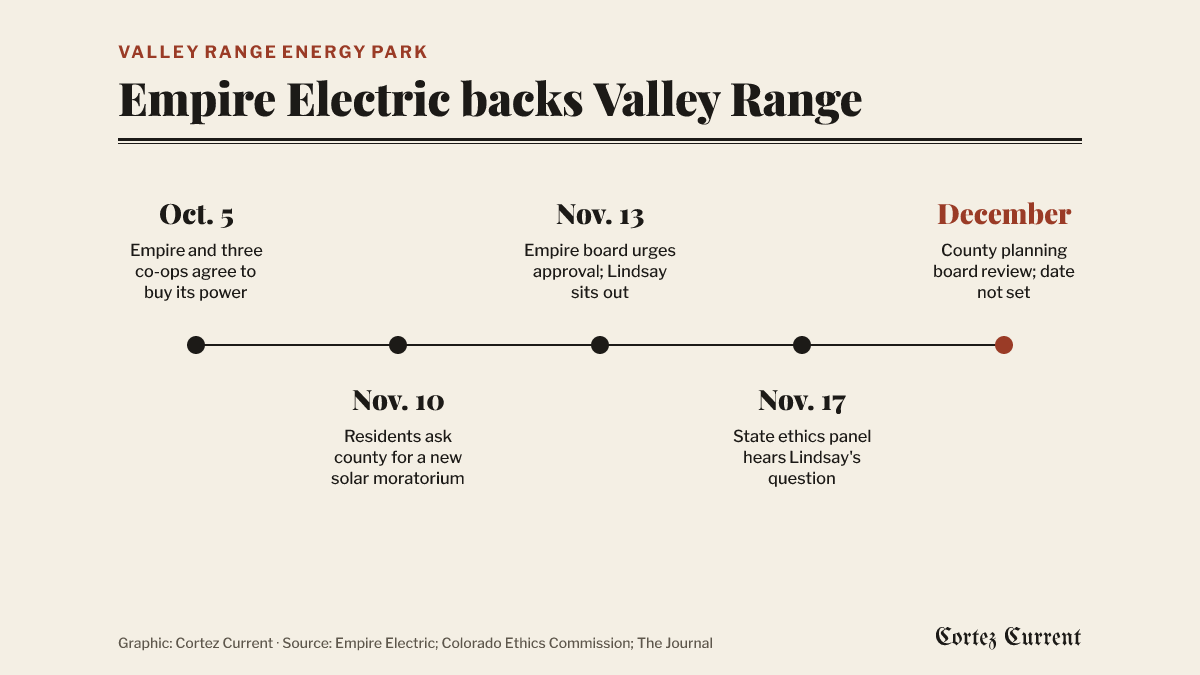 Graphic: Cortez Current. Source: Empire Electric Association; Colorado Independent Ethics Commission; The Journal
The chair of the county Planning and Zoning Commission told members Nov. 12 that the commission will review the Valley Range application in December. No date, time or place has been announced. The commission will make a recommendation, and the county commissioners will decide.
The state ethics commission’s written opinion on Lindsay’s question could come within days. Advisory opinions are posted on the commission’s website.