Valley Range neighbors ask county to bring back solar moratorium
Eight residents used Tuesday's commissioners meeting to ask for a new moratorium on large solar and battery projects. One said the petition drive that helped end the last one was run by a national PR firm and a Denver canvassing company. Both firms' own websites describe work in the county.

The fight over the proposed Valley Range Energy Park moved to the county commissioners’ public-comment microphone this week, a week after a county commissioner race in which the project was a central issue.
At Tuesday’s meeting, eight residents asked commissioners to put a stop to new large solar projects while the county starts over. Most read nearly the same statement. They asked the board to reinstate its moratorium on utility-scale solar, add battery energy storage systems to it, apply it to “all pending projects” and repeal Chapter 10 of the county land use code, the section that allows those projects.
Valley Range, which would put up to 125 megawatts of solar panels and a 62.5-megawatt battery system east of Cortez, is one of the projects pending under that chapter.
“An act of political theater”
The first speaker, Bryan Davis of County Road H, said that at the previous day’s “coffee with the county” he had “presented the commissioners with clear, irrefutable evidence” that the board had been misled at its Nov. 18, 2025 hearing. At that hearing, commissioners declined to renew the moratorium and adopted the new solar rules.
Davis said a group “masquerading as a grassroots movement” gave the board “355 petitions supposedly gathered from canvassing 500 homes.” He said it was “an act of political theater paid for by a developer, designed and directed by a national PR firm called Bantam Communications, and staffed by paid canvassers provided by a Denver firm called Open Answer.” He said the firms had published case studies taking credit.
He did not say in his three minutes which developer he meant. The Cortez Current asked Davis for the evidence he gave commissioners, and he declined to share it.
In an email, he wrote that he is “deeply distrustful of a new publication that appears just in time to try and influence the vote on a $240,000,000 project.” He added: “I hope your article gets this right, and I hope my suspicion is unfounded, but I’m afraid you will have to follow the breadcrumbs yourself.” He said Bantam “hasn’t taken anything down.”
Davis and Joanne Haruta own the Dotty Wampus Magical Chocolate Factory, a chocolate tour and tasting business on County Road H. They also built NoValleyRange.com, the website of a neighborhood group fighting the project. The site asks people to sign a petition against Valley Range and donate to fight it, and says Davis, Haruta and a group of neighbors paid for its first social media ads. It says neighbors who tried to negotiate with Accelergen found the company “impossible to negotiate with.” On Nov. 2, the chocolate factory’s Facebook page thanked “all 1,267 petition signers”; the Current has not seen the signatures. In an Oct. 5 press release, the group put the project’s cost at $240 million.
Another speaker, a Road H resident named Angela, started by praising commissioners for walking residents through the budget the day before. “I was very impressed with the management of the funds,” she said. She then asked the board to “reset the clock to before the BOCC was so rudely manipulated.” She also asked it to formally request Commissioner Kent Lindsay’s resignation.
“This is not intended as a personal attack on Kent,” she said. “We recognize that he may have been operating with incomplete or misleading information. However, his involvement in advancing Chapter 10 places him at the center of a process that now raises serious legal questions.”
The county’s minutes show it was Lindsay who moved to adopt those rules at the Nov. 18, 2025 hearing. The Current’s email asking Lindsay for comment was blocked by the county’s email filter.
Four residents of Road 29.4 Loop read the same statement nearly word for word. Each began: “In light of the information and evidence concerning outsiders manipulation that was presented yesterday in the commissioner’s coffee…” A fifth Road 29.4 Loop resident asked that the solar chapter be “revisited without conflicts of interest.” A Road H resident said, “Deception and manipulation does not belong in Montezuma County.”
Commissioners thanked each speaker and moved on. No moratorium was on the agenda, and the board took no action on the requests.
Republican Rodney Cox, who is projected to win the District 1 seat over Democrat Rebecca Busic, opposed Valley Range during the campaign. The new commissioner takes office in January.
What the firms say they did
Bantam Communications, a public affairs firm based in Charlottesville, Virginia, is Accelergen’s public relations firm. In October it told the Current the company would answer questions about Valley Range. A “Where We Work” map on Bantam’s own website lists “Cortez, Montezuma County” among its locations.
A profile of Bantam on the website yespress.io, last updated in September, describes “a newer case from southwestern Colorado.” There, it says, “a six-month solar moratorium looked like a technical pause, but Bantam interpreted it as political risk.” According to the profile, canvassers reached nearly 5,000 residents and were told to walk away from hostile conversations, and “officials ultimately voted unanimously to lift the moratorium and adopt a workable solar ordinance.” The profile does not name the county or the client.
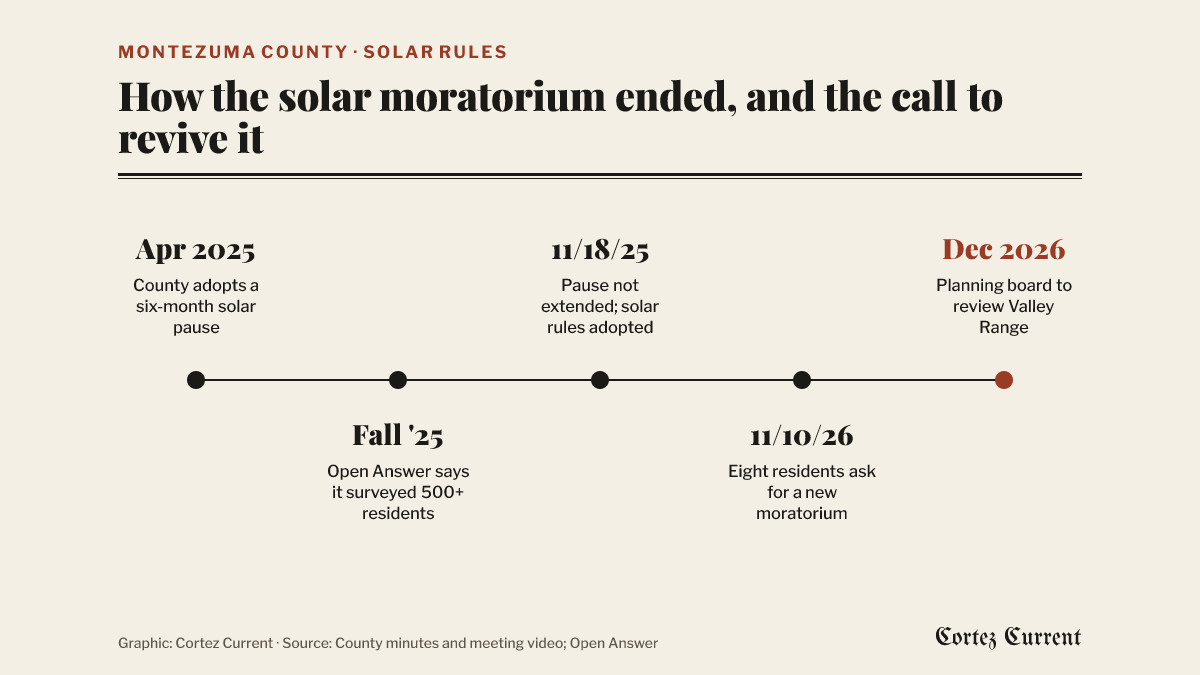 Graphic: Cortez Current. Source: Montezuma County minutes and meeting video; Open Answer
Those details match Montezuma County’s. Commissioners adopted a six-month pause on new utility-scale solar applications in April 2025. On Nov. 18, 2025, they declined to extend it and adopted the new solar rules instead. The county’s minutes say the motion carried but don’t record whether the vote was unanimous.
Open Answer, the Denver firm Davis named, calls itself a nonprofit that connects with people “at their doorsteps and on the street” for “mission-driven efforts” in Colorado. It was created by the nonprofit Healthier Colorado. In an April post on its website titled “How Montezuma County Residents Feel About Solar,” Open Answer says its canvassers surveyed more than 500 county residents from September to November 2025. They also “turned out 19 people for a public hearing on a Tuesday morning,” the post says, and after 14 of its supporters spoke, commissioners lifted the moratorium. Nov. 18, 2025 was a Tuesday.
According to the post, commissioners “found it hard to believe” that 75.8% of the residents surveyed supported or leaned toward supporting solar projects, and wondered whether answers from Cortez had skewed the results. Open Answer says support was 80% in responses from outside Cortez. The post does not say who hired the firm.
Local residents organized, too. On Oct. 14, 2025, The Journal reported that Montezuma County for Solar, organized by Julie Hudak, David Paradise and Kate Bennett, had collected more than 200 petition signatures urging officials not to extend the moratorium, and that its volunteers had surveyed more than 300 people. Hudak and Bennett were among the public commenters at the Nov. 18, 2025 hearing, the minutes show.
Bantam and Open Answer did not respond to emailed questions by Saturday.
Valley Range’s pitch
The same evening, Valley Range held a community meeting at the Destination Grill, with what it called “informational stations where you can speak directly with subject matter experts.”
In a Facebook post afterward, Valley Range thanked “the 75+ community members” who came and posted the boards from the meeting. Among them are before-and-after simulations of the view from County Road 29.4 Loop and Road H, the two roads where Tuesday’s speakers said they live.
The display boards make the project’s case:
- Taxes and jobs: If approved, the project would provide “103 jobs for construction & operations,” “$18M in new property taxes” and “$7.8M in local earnings.”
- Who buys the power: Empire Electric Association, Gunnison County Electric Association, San Luis Valley Rural Electric Cooperative and San Miguel Power Association. They would buy it through Tri-State Generation and Transmission’s “Bring Your Own Resource” program. The developer says the arrangement would save the co-ops more than $20 million.
- Size: 900 buildable acres. Another 1,100 acres would go to setbacks, conservation land, wildlife migration corridors and “ecology leasing.” The battery containers would cover less than an acre, with “2-3 acres for entire BESS yard.”
- Timeline: Planning and Zoning and commissioners’ hearings in fall 2026 and winter 2027, construction in 2028 and operation in 2029.
 The developer’s proposed site plan, one of the boards from the Destination Grill meeting, showing the buildable area, conservation land, a migration corridor and the approximate battery storage location between U.S. Highway 160 and Road H. Image: Valley Range Energy Park (Facebook)
Opponents drew their own. On Oct. 11, the Dotty Wampus Magical Chocolate Factory posted a map of the project, a version of the “to scale” map on NoValleyRange.com’s home page, with a line marked off in miles toward the park. The post said Accelergen had told The Journal the solar field “would be about three miles northwest of Mesa Verde.” “I made a map,” it said.
 The opponents’ map of the proposed solar panels and battery storage, with a line marked off in one-mile segments to the Mesa Verde National Park marker on the map. The Current has not checked its scale. Image: Dotty Wampus Magical Chocolate Factory (Facebook)
The boards also say “Accelergen maintains full control over its projects.” Accelergen Energy is the developer. In October, the trade publication Mercom reported that Fengate Asset Management, an infrastructure investment manager, had closed its purchase of Accelergen. Mercom reported that Accelergen’s management team will keep overseeing development of its projects.
Some opponents online describe Fengate as a data-center company and suspect the project is meant to power one. Valley Range has denied that. “The developer has confirmed it has no connection to any data-center developer,” it posted on Facebook in late October.
What has solar done for the county?
On Tuesday morning, Cheyenne Harris asked a question in the public Facebook group The Original What’s Up? Dolores, Mancos, Cortez!
“What is Montezuma County’s take on solar? Why do or why do you not support it?” she wrote. “Genuinely looking for input on this topic. Not here to start a heated argument.”
She asked what the county’s existing solar farms have done for it, such as the array near Totten Lake, which she said was pitched as a way to keep power costs down. “Curious of where to find the details regarding how these established solar farms have benefited the county thus far,” she wrote. “I refuse to pay for the journal newspaper articles but trying to find information on these topics is a challenge.”
By Wednesday morning the post had 125 comments, from flat refusals to strong support.
Against, mostly over the location:
- “Not on the front porch of Mesa Verde….. Are they insane…..” — Randy Forsythe
- “Come and visit where they want to put it. It will totally disrupt our views and way of life. A BESS plant surrounding our community on a dead end road leaves our safety at risk. It’s right at the base of Mesa Verde.” — Tricia Rotarius Hale
- “EEA says it will help lower your bill, it won’t. … putting them at the bottom of Mesa verde is diabolical. SW Colorado is a tinderbox as it is.” — Keesha Rose Carignan
- “There is no guarantee it’s going to help lower our bills. Someone is going to make money off the solar farms and it’s not going to be us.” — Angela Randall-Salazar
- “If this was only a solar project and was actually built and used by Empire Electric … AND it wasn’t next to Mesa Verde, possibly this wouldn’t be an issue. BUT that is not what this is. It a private company, selling energy to us.” — Cindy Ruatti
For solar, or at least not against it:
- “I am all for it. We need to begin the process of transferring to renewable … We also need a cheaper alternative to gas power which only ever seems to get more expensive.” — Derek Beckman
- “I prefer renewable energy sources over petroleum and coal. I am fed up with the not in my backyard attitude.” — Gina Roberts
- “I have to be honest and say it wouldn’t bother me. Progress is going to happen.” — Shirley King
- “I am all for solar. If this project was not located in the view zone from Mesa Verde, I’d support it. It just doesn’t belong there.” — Terry Sano
In between:
- Somerset Doolen, who says the project would be in view of the property: “I worked so hard to buy a place and now my view could be solar panels…which if it happens I will grow to deal with…but it doesn’t mean I want it nor does it mean I’m against solar power.”
- Edward Anderson said any developer using the local grid should make “a 40-year commitment” to help pay to expand and maintain it, “so that our utility costs don’t continue to go up.”
- Several people, including Debbie McHenry, Andrea Martin, Danette Dillon and Michael Harvey, suggested putting panels on rooftops and over parking lots instead of open land. Harvey, who has panels on his house, wrote that he will not recover their cost over the system’s 25-year life.
- Tristan Cook wrote that solar is a good idea “but it needs to also make local jobs and be beneficial for the area its in.”
Elise Goggin pointed people to the co-op. “If you pay an electric bill in Montezuma County you are a member/owner of Empire Electric Association,” she wrote. “If you are actually curious about the real benefits of the existing solar and the proposed solar, I encourage you all to reach out to our co-op for answers.”
Some numbers that bear on Harris’s question:
- The existing arrays are small. Empire buys power from three local solar projects built by OneEnergy: Totten (2.8 megawatts, near Totten Lake), Rocky Ford (2.6 megawatts, southeast of Cortez) and Montezuma (6.4 megawatts, northwest of Cortez). OneEnergy says together they were expected to supply nearly 5 percent of the energy Empire delivers. Valley Range would be roughly ten times their combined size.
- Property taxes: The Current has not found a public total of what those arrays pay.
What comes next
At its Nov. 12 meeting, the chair of the county Planning and Zoning Commission said the commission will review the Valley Range application in December. No date, time or place has been announced, and as of the Current’s last check the application had not been posted for public review. The planning commission makes a recommendation; the Board of County Commissioners decides. Written comments on land-use applications must be filed through the county’s online planning portal at least seven days before each hearing. The Current’s earlier coverage is collected on its Valley Range page.
Sources: Montezuma County Board of County Commissioners meeting video, Nov. 10, 2026 (public comment, about 6 to 16 minutes in; names as spoken for the record) · Montezuma County Board of County Commissioners minutes, Nov. 18, 2025 · Bryan Davis, email to the Cortez Current · NoValleyRange.com · NoValleyRange press release, Oct. 5, 2026 · Bantam Communications · yespress.io profile of Bantam Communications, last updated Sept. 19, 2026 · Open Answer, “How Montezuma County Residents Feel About Solar,” April 16, 2026 · The Journal, “Montezuma County residents petition to end solar moratorium,” Oct. 14, 2025 · Valley Range Energy Park Facebook posts (Nov. 2 simulations; Nov. 11 meeting boards) · valleyrangeep.com · Mercom, “Fengate Asset Management Closes Acquisition of Accelergen Energy,” Oct. 8, 2026 · OneEnergy Renewables’ Empire Solar project page · Cheyenne Harris’s post and comments, The Original What’s Up? Dolores, Mancos, Cortez! (Nov. 10 and 11) · Cortez Current Valley Range coverage