One in five Ute Mountain Ute students was disciplined, RE-1 told
The district's annual Indigenous policies report, presented October 27, counts 45 of 220 Ute Mountain Ute students suspended or expelled last year against 95 of 1,494 non-tribal students. Native American graduation rates at M-CHS rose almost 19 points.
One in five Ute Mountain Ute students in Montezuma-Cortez School District RE-1 was suspended or expelled during the 2025-26 school year, according to the report the district presented to its Board of Education on October 27.
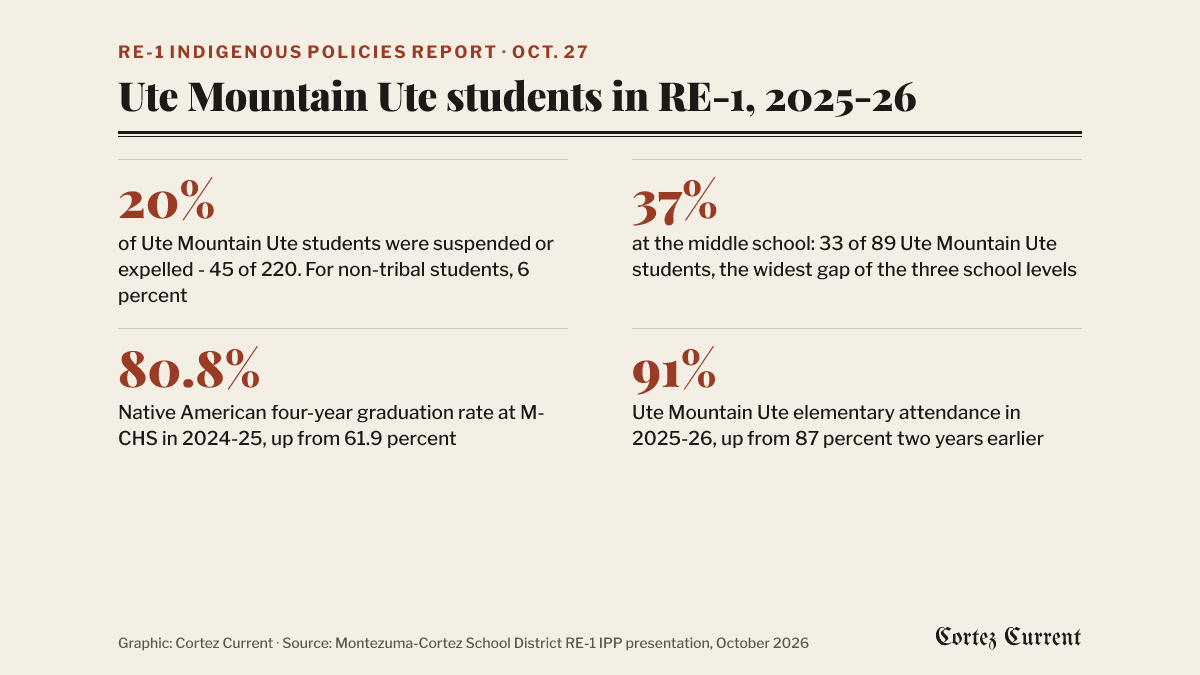 Graphic: Cortez Current. Source: Montezuma-Cortez School District RE-1 Indigenous policies presentation, October 2026
The figure is 45 of the district’s 220 Ute Mountain Ute students, or 20 percent. For students the report calls non-tribal affiliated, it is 95 of 1,494, or 6 percent.
The gap is widest in the middle grades. At Montezuma-Cortez Middle School, 33 of 89 Ute Mountain Ute students — 37 percent — were suspended or expelled, against 56 who were not. Ute Mountain Ute students accounted for 65 of the 193 out-of-school suspensions handed out at the middle school, a third of the total. At the elementary level the share was 7 of 70 suspensions, and at the high school it was 8 of 16.
Graduation rates are climbing
The same report carries the district’s best numbers of the night. The four-year graduation rate for all Native American students at Montezuma-Cortez High School rose from 61.9 percent for the class of 2023-24 to 80.8 percent for the class of 2024-25 — a jump of almost 19 points, which the district’s own slide calls out. The rate for all M-CHS students in 2024-25 was 87.0 percent.
District-wide, including the alternative education campus, the Native American four-year rate went from 58.3 to 67.7 percent over the same two classes, against 76.3 percent for all students. The drop-out rate for Native American students in grades 7 through 12 was 5.5 percent district-wide in 2024-25, against 3.7 percent for all students. The district says its 2025-26 graduation and drop-out figures are not final.
Attendance has improved too. Ute Mountain Ute attendance at the elementary level went from 87 percent in 2023-24 to 91 percent in 2025-26, and at the secondary level from 83 to 85 percent.
The test-score gap
On the state’s CMAS tests last spring, 6 percent of Ute Mountain Ute students in grades 3 through 5 met or exceeded grade-level standards in reading and writing, against 39 percent of non-tribal-affiliated students. In math it was 8 percent against 30 percent. In grades 6 through 8, no Ute Mountain Ute student met the math standard, against 24 percent of non-tribal-affiliated students.
On the PSAT and SAT in grades 9 through 11, 20 percent of Ute Mountain Ute students scored college-ready in reading and writing, against 60 percent; in math it was 8 percent against 29 percent.
Growth — how fast a student improves against academically similar students statewide, where 50 is average — was the one bright spot in the testing section. Ute Mountain Ute high schoolers posted a median growth percentile of 54.5 in math, which the report flags as improved and high. Elementary and middle growth ran well below the goal: 32 in elementary math against 45 for non-tribal-affiliated students, and 32 in middle-school math against 51.
The report also shows that 22 percent of Ute Mountain Ute students receive special education services, against 15 percent of all district students, and that 2.3 percent are identified as gifted and receiving services, against 7.1 percent district-wide. Participation in extracurricular activities runs the other way: 63 percent of Ute Mountain Ute students at the middle school took part last year, and 37 percent at the high school, both slightly above the rate for all Native American students at those schools.
The meeting itself
The report went to a board meeting the district holds once a year, on the fourth Tuesday in October, so that parents of Indigenous children and the tribes can comment on the district’s programs. It was held at 6 p.m. on October 27 in the Montezuma-Cortez High School library. The agenda states plainly that this meeting “is not broadcast on our YouTube,” and no recording of it has been posted, so the Current could not hear the discussion or the vote.
The one action item was approval of the 2026-27 Federal Indigenous Policies and Procedures. The version in the district’s own document library now carries the line “LEA Board Approval Date: October 27, 2026” and is signed by board President Dr. Joshua Shumway and board Secretary Mike Lynch — the written record that the board adopted it. The minutes, which will list the roll, go to the board’s regular meeting on November 17.
The packet also includes a written response letter from the Ute Mountain Ute Tribe. It is a scanned image rather than text, and the Current was not able to read it; it is posted in full with the rest of the meeting’s documents.
What the policies require
The adopted policies commit the district to emailing the tribes and parents of Indian children its Impact Aid application, its assessment of equal participation, the policies themselves and any education program plans at least 30 days before any meeting to discuss them, with reminders a week and three days out. They set monthly meetings on the second Tuesday with the Native Parent Advisory Committee, a spring questionnaire for parents and tribal officials, and a written district response each year to comments received. If participation in the consultation is low, the district commits to changing its communication method or the meeting time.
The policies also require the district to calculate annually, from its own records, how Indian children compare with non-Indigenous children across assessments, attendance, suspensions and expulsions, discipline, drop-out and graduation rates, special education, Title VI-assisted programs and sports and extracurricular participation — which is what the October report is. Where gaps are found, the board commits to modifying the education program, in consultation with the tribes and parents, to improve participation.
The meeting agenda and every document presented are on the district’s board portal.
No student is named in this story. The district’s reports present numbers for groups of students, not individuals, and the Current does not name students.