County weighs flood recovery contract and an open-range pay plan
At Monday's workshop, the emergency manager asked for a four-month contract to help run flood recovery, and a consultant's pay study proposed moving most county jobs onto a nine-level open-range plan. Both were set for decisions Tuesday.
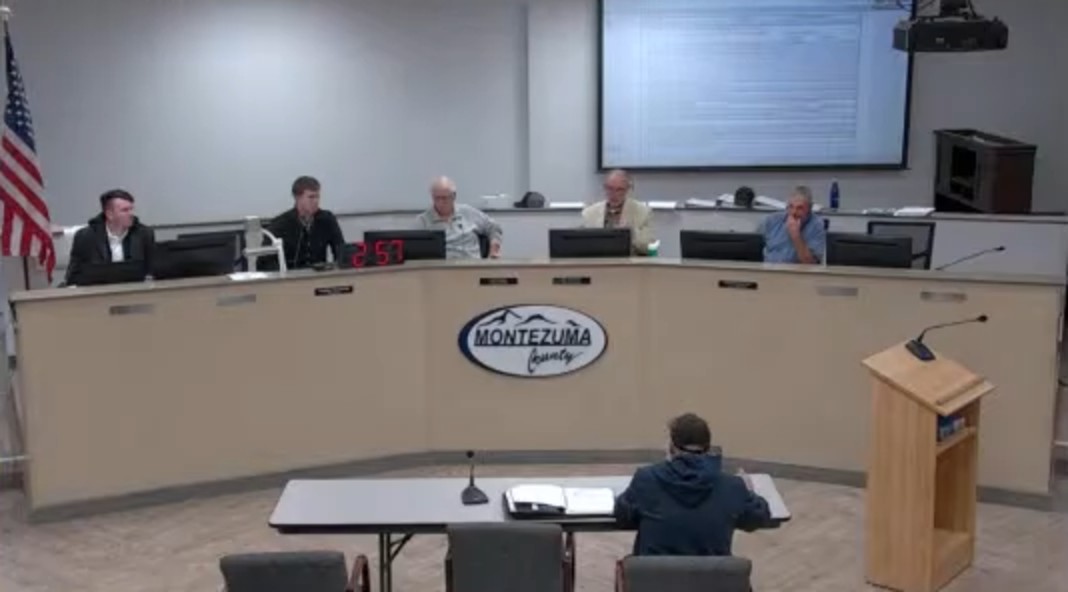
Montezuma County’s emergency manager asked commissioners on Monday, Nov. 23, to pay for a contract worker to help run the county’s flood recovery for the next four months, and a consultant presented a countywide pay study that would move most county jobs onto a new open-range pay plan.
Both items were on the agenda for decisions at the board’s regular meeting on Tuesday, Nov. 24. The recording of that meeting had no captions when this story was written, so this story covers Monday’s discussion; the Current will report what the board decided once it can review Tuesday’s meeting.
The workshop recording is on the county’s YouTube channel, and the county posted the agenda with the Nov. 23 workshop video.
Help for flood recovery
County Emergency Manager Jim Spratlen told commissioners he is “running out of bandwidth” as the work shifts from the flood response to recovery. Several Southwest Colorado counties are hiring local disaster recovery managers, he said, and Montezuma County still has to track damage data, write incident support plans, reach residents and water groups whose property was damaged, and keep the paperwork that federal and state reimbursement will demand.
The resource request he put on screen, dated Nov. 17, asks for a planning section chief “trained and able to perform all duties within the Planning Section” from Nov. 17 through March 31, 2027, at 40 hours a week with no overtime, “for recovery operations,” at $55 an hour for 704 hours. That comes to $38,720. Spratlen said he wanted to keep the person who had already been doing the work for the county’s emergency operations center, who he said stopped working for the county the previous Friday night.
He proposed 40 hours a week for the first month and then hours as needed, tapering off by February or March, and offered a shorter fallback: “Plan A, give me four months. Plan B, give me two months.”
Commissioners pressed on two points:
- Cost recovery. Asked whether the cost could be recovered, Spratlen said it could be reimbursed if a federal disaster declaration is signed, and that a state agency had told him a position labeled as a local disaster recovery manager could be reimbursed in full. One commissioner noted that reimbursement is not guaranteed and that the county’s past requests, including for earlier flooding, had been denied.
- How the contract is awarded. One commissioner asked whether the county should seek other candidates rather than effectively sole-sourcing the job, and suggested approving it only through the end of the year and then re-evaluating. County Attorney Stephen Tarnowski said he would need to think further, but that the county had already documented the road and bridge engineering work as an exigent circumstance justifying sole-source procurement, and that a similar memo could cover this position. Spratlen said recovery managers hired from outside cost $151 to $246 an hour and do not know the area.
Spratlen also told the board the county’s emergency operations plan must be completed by December 2027 and that its hazard mitigation plan has expired, which he said will take 12 to 18 months and funding to redo. One commissioner said the county’s estimate for damage to headgates and waterways is low, saying the Weber ditch alone will cost “way over a million and a half dollars” to make usable by spring.
“We’ll make that decision tomorrow. This is just conversation,” one commissioner said.
The pay study
A consultant from Pontifex, the firm the county hired after a request for proposals, presented its classification and compensation study by video. The firm had every employee fill out a position questionnaire, rewrote the county’s job descriptions in one format, tested each job against federal overtime law, and compared the county’s jobs with what its competitive labor market pays. The consultant said the firm will give the county a year of support at no charge.
Human Resources Technician Dennis Bugg told commissioners what the study recommends:
- Road and Bridge keeps the pay plan the county already adopted for it; the study found it on point.
- Most other jobs move onto an open-range plan with nine levels, A1 through A9. Dental and legal positions are handled separately. Bugg said an open range lets the county give a raise of any size and move everyone up evenly, which a step plan does not.
- Seven employees fall below the minimum of their new range, Bugg said, and bringing them up would cost “very minimal.”
- The sheriff’s office has its own plan, which must be negotiated with the Fraternal Order of Police later.
Bugg said a few job descriptions still have to be finished with Pontifex and reviewed with department heads. The descriptions were written for the job rather than the person in it, he said, so that the county knows what to expect of the next hire.
Other workshop business
- 2027 holidays. HR presented the 2027 holiday schedule. Because New Year’s Day 2028 falls on a Saturday and county offices are closed Fridays, the holiday is observed Thursday, Dec. 30, 2027, so 11 paid holidays fall in calendar 2027 and nine in 2028. Commissioners said they were fine keeping 10 holidays a year.
- Peace officer fund. Undersheriff Tyson Cox asked the board for a resolution certifying that the sheriff’s office will spend money from the Peace Officer Training and Support Fund, created by Proposition 130, only as state law allows. He said each agency is first allocated $15,000, that the money can go to recruitment, retention, training, equipment and programs, and that it cannot replace money already budgeted.
- Transfer orders. Robert Dobry reviewed four transfers: $794,895 from the Law Enforcement Authority fund to the general fund for budgeted 2026 expenses; $64,619 from the E911 fund to the general fund for administrative and mapping support; $40,291.50 from the general fund to public health, the county’s yearly $1.50-per-resident contribution based on a state estimate of 26,861 residents; and $24,270 from the capital fund to the general fund to cover the Annex III solar lease buyout, which Dobry said he believes is the last of the county’s solar buyouts.
- Background checks. County Administrator Michael Rime presented Policy 26-06 on pre-employment background screening. It largely writes down current practice but lets Human Resources recommend an early start when a pending check would delay a needed hire, with the new employee let go if the check later fails. It does not apply to social services, the health department or law enforcement jobs.
Social services board
Before the workshop, commissioners sat as the Board of Social Services. They approved the October minutes and $1,436,597.32 in October payments, and voted to approve two items:
- An AI policy for the Department of Social Services. The county’s human services director said the department is using an approved AI tool for document management in child welfare and adult protection, and that the policy sets out responsible use, confidentiality and data security, and requires staff to check anything the tool produces. The director said the tool does not replace a caseworker’s judgment. County administration said a broader countywide AI policy is being drafted with the IT department.
- A state transit grant agreement. The board approved the state’s sub-award contract for the federal Section 5311 rural transit grant, which the director said totals $277,330, with $76,165 in local match.
The director also walked through the department’s 2027 budget, which the director said expects $18,569,312 in revenue and covers 46 employees. The director flagged county transportation as the budget of most concern: Medicaid reimbursement rates were cut substantially in July, the director said, and medical rides move to the state’s broker, MediDrive, with bookings for January rides starting in December, as the Current reported. The director said the transportation fund should carry about $100,000 into next year, but if broker payments fall short the options are raising fares on other public rides, finding grants, or cutting programs.
Senior services is in better shape, the director said, helped by one more year of carryover funding. Service units grew from 12,755 to 19,541 between 2022 and 2025 and the number of people served from 291 to 421, according to the director.
Figures and quotes in this story are from the county’s recording of the meeting, except the contract terms, which are from the resource request shown on screen. The Current names county staff only as they appear in the county’s written agenda or its own records.
Update, November 25, 2026: At their Nov. 24 meeting, commissioners approved the planning section chief 2-1 in 30-day increments with no back pay, and put off the pay plan decision. Read the follow-up: County approves flood planning chief month to month, delays pay plan.