County denies two tax appeals as owners say notices never arrived
Sitting as the Board of Equalization, commissioners upheld the assessor on two abatement petitions and cut a Dolores building's commercial share from 80 percent to 60. Both denied owners said county mail never reached them.
Montezuma County commissioners heard three property tax abatement petitions on Tuesday morning, denying two and ordering a third property reassessed. In both of the denied cases the owner told the board that county notices had gone to an address the county had been asked to change, and a resident used the public comment period afterwards to say the county should be sending such notices by certified mail.
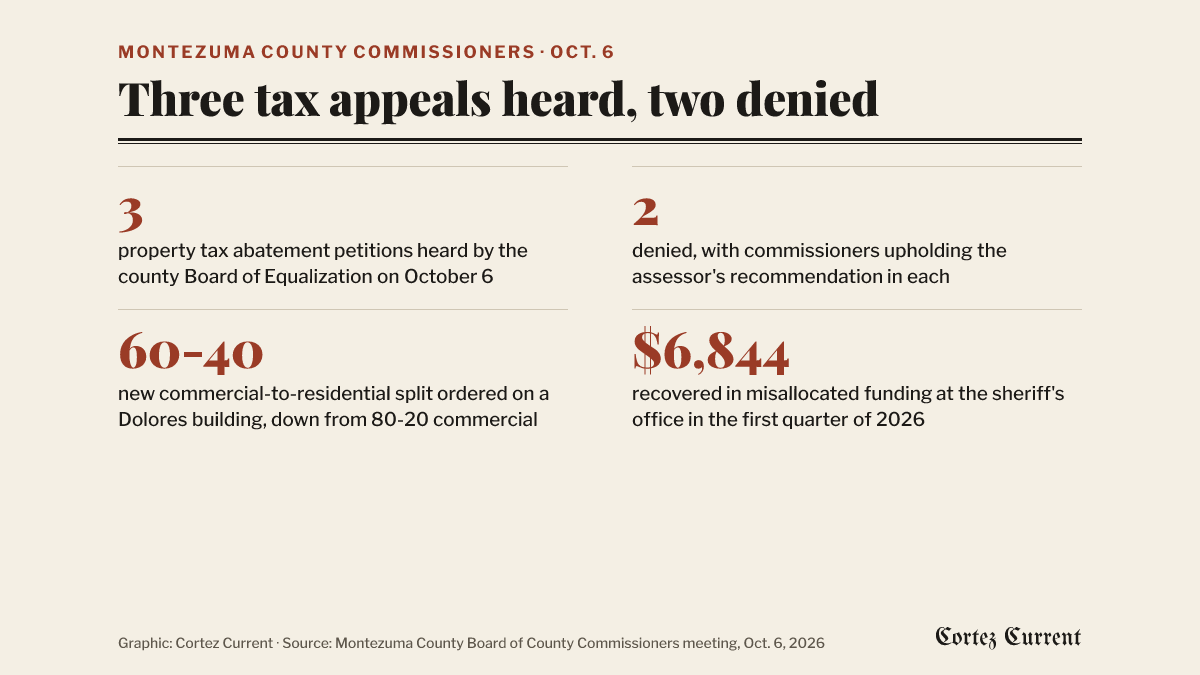 Graphic: Cortez Current. Source: Montezuma County Board of County Commissioners meeting, October 6, 2026
Commissioners sit as the county Board of Equalization to decide abatement petitions. County Attorney Stephen Tarnowski explained the process at the start of each hearing: an abatement corrects taxes that have been levied erroneously because of an erroneous valuation, an irregularity in levying, a clerical error or an overvaluation, and state law limits it to two years back. Each side gets 15 minutes, the board then discusses and rules, and county staff issue a written decision afterwards.
The ranch
The first petition, for tax year 2024, came from the owner of a ranch who asked the board to restore the property’s agricultural classification. He did not dispute that no cattle were on the land in 2024, but argued that the reason mattered.
He pointed the board to a provision of state law that keeps the agricultural classification in place for the year a parcel’s productivity is destroyed by a natural cause and the four tax years after it, so long as the assessor receives evidence that the owner is rehabilitating the land for agricultural use. The statute lists removing debris, restoring fences and agricultural structures, reseeding, providing water for livestock and contouring the land among the kinds of evidence that count.
The owner said a heavy winter in 2022-23 and a large spring runoff in 2023 blew out stock ponds, silted up drainages and damaged culverts and ranch roads, and that rehabilitation work ran through 2024 and 2025. He said he had submitted invoices, photographs and contractor records, and that cattle are back on the property now.
The county assessor recommended denial. She told the board there have been no cattle on the property since it was bought in 2021, that fences are still down with no cattle guard at the highway access, that the ponds have not had silt removed, and that she could see no evidence of reseeding beyond natural growth. Staff had been on the property about three weeks earlier, she said, adding that she did not dispute the land needs reclaiming but that reclamation “doesn’t take this long.”
Commissioner Gerald Koppenhafer recused himself from the hearing, as he had from an earlier one on the same property, telling the board that a nephew of his holds the grazing lease. The two remaining commissioners voted to uphold the assessor’s recommendation. The owner asked that the written decision address the rehabilitation statute specifically; the chairman said it would.
The $400 bill that became $18,000
The second petition, for tax year 2025, came from an owner whose taxes went from a little over $400 to about $18,000 after the county took the property out of agricultural status. Part of the increase, he said, had already been resolved: an older building he had moved from the middle of the ranch had been treated as a new dwelling, and that had been corrected.
What remained was the agricultural classification. The owner said he had not received the county’s notices, that he has persistent problems with mail delivery, and that when he did reach the office he was told there was a mistake and not to pay. He said he made repeated calls and did not get a return call for weeks.
The assessor said the office sent notices in September and December 2024 after the 2023 purchase triggered a review, that no response came, and that a notice of value went out in May 2025 moving the property to vacant land. The owner supplied a signed grazing lease in March 2026, she said, and the office granted agricultural status for 2026 — a year earlier than it had to, since the classification normally takes two years to establish. For 2025, she said, there was no agricultural use.
When the owner asked whether the county sends notices by certified mail where the stakes are that high, the assessor said the office cannot: it has about 23,000 accounts and cannot pay for return receipts on the notices it is already required by statute to send. The board voted to uphold the assessor’s recommendation.
A Dolores restaurant gets a new split
The third petition succeeded. The owners of a Dolores building that houses a restaurant on its ground floor and the family’s living quarters above asked the board to change the share of the property taxed as commercial.
The assessor’s office had the building at 80 percent commercial and 20 percent residential, based on a field visit and a March 2025 email from the town’s then building official and fire marshal, who wrote that a new certificate of occupancy in 2023 changed the first floor to a restaurant classification and the second floor to residential. The building is in a commercial zone, and the office put its total value at $516,459.
The owner told the board the restaurant and its kitchen, bathroom and dish room take up 934 square feet of a building of 5,180 square feet, and that the rest is either where the family lives or an attic that is boarded off and unusable. After discussion, commissioners moved to reassess the property at 60 percent commercial and 40 percent residential, and the motion carried.
Public comment on the notices
One resident spoke during public comment, telling the board it was wrong for the county to say it cannot afford certified mail on notices that affect people’s lives. She said that in any business she had worked in, a letter that drew no response would be followed by a certified one, and that the cost is part of overhead. She also said residents should send address changes by certified mail rather than phoning them in.
Racetrack lease terminated
Commissioners signed a notice terminating the county racetrack lease, a week after sending staff to ask the parties whether either still wanted to proceed and a day after agreeing at a workshop to let the operators out of the final year. The tenants had written to say they cannot fund the 2027 season of what was written as a three-year contract.
The county attorney said the notice treats the tenants’ statement that they will not perform as grounds for termination on 30 days’ notice, requires the racetrack to be returned in good condition, and authorizes the interim county administrator to release them from their remaining obligations if an inspection finds it is.
Other business
Commissioners approved an intergovernmental agreement to have the county handle information technology management for the City of Cortez, a stop-gap the board was told runs to the end of the year with month-to-month extensions through March while the city, whose technology director is leaving, decides on a longer arrangement.
A possible appointment was pulled from the agenda. The chairman said that with two applicants it would be fairer to hold interviews first, as the board had done for an earlier vacancy. At their workshop the day before, commissioners had expected to fill a county fair board seat at this meeting.
The board also approved the minutes of its September 29 meeting, a three-item consent agenda, and a retail liquor license renewal for a business on Highway 491 in Lewis after the sheriff’s office reported no violations. The planning department brought two subdivision plat mylars for signature.
Commissioners proclaimed October 3 to 10 National 4-H Week after a presentation from the county extension office, which said the local program had 239 members and 56 volunteers last year. Staff invited the public to Tour de 4-H at IFA on October 10, a recruitment event run as a fall festival with games, club tables and a free lunch.
The board also voted to rescind the county fire ban, effective at 6 a.m. Wednesday; our story on that is here.
Legal and administrative reports
Tarnowski told the board the U.S. Supreme Court heard oral argument Monday in the Colorado climate-liability case the county joined an amicus brief in, that the argument ran close to two hours rather than the usual 45 minutes, and that one justice has recused himself, leaving eight to decide it. An opinion is not expected until the end of the term in June 2027, he said, and the audio is public.
On the county’s Ironwood case, he said the county has filed its proposed order and the court has not ruled. A status conference is set for Monday and a hearing on the county’s contempt motion — which alleges the company failed to comply with court orders to remove waste from the site — is set for the Friday of the following week. He said he is also continuing settlement discussions with the other attorneys in the case, and that the revised land use code and a resolution on the county’s planning procedures are due back before the board next week.
Interim County Administrator Travis Anderson said the county expects to put its share of a regional fiber project — which he put at roughly $650,000 to $700,000, rounding up — into next year’s capital budget, pending a grant. He said he and human resources staff had met the president of the Fraternal Order of Police about current policy while negotiations continue.
Anderson also told the board that an internal affairs investigation at the sheriff’s office appears to be completed and has been forwarded to other entities, and that county administration identified and recovered $6,844 in misallocated funding for the first quarter of 2026. No findings and no charges were described at the meeting, and the board took no action on it. The county sent sheriff’s office timekeeping records to the district attorney in September.
Clerk and Recorder’s office staff told the board that ballots went out Monday. Our voter guide has drop box locations, in-person voting dates and what is on the ballot.
Commissioners reported on a Southwest Water Conservation District personnel committee meeting, a Colorado Counties Inc. meeting that took up unfunded mandates, a meeting with residents at the livestock auction in Lewis, and a Western Interstate Region board meeting in Cañon City, where federal payments to public-lands counties were discussed. A bill to reauthorize the Secure Rural Schools program for three years was introduced during that meeting, the chairman said.
After an executive session called to take legal advice, the board voted to cancel a review of the Employers Council’s human resources services for the county public health department, one commissioner saying the situation there appeared to have been resolved. Tarnowski said on the record that only the people named in the motion were present, that only that topic was discussed, and that no decisions were made in the session.
This account is drawn from the county’s recording of the October 6 meeting. Written minutes have not yet been published. Petitioners in the abatement hearings are private individuals and are not named here.