Home bakers can sell pumpkin pie starting Jan. 1, just too late for Thanksgiving
Colorado's expanded cottage food law also opens the door to homemade tamales, burritos and other refrigerated foods. Sellers will have to register with the state.
 AI illustration
Colorado home bakers working under the state’s cottage food law still can’t sell a homemade pumpkin pie this Thanksgiving. Starting Jan. 1, they can.
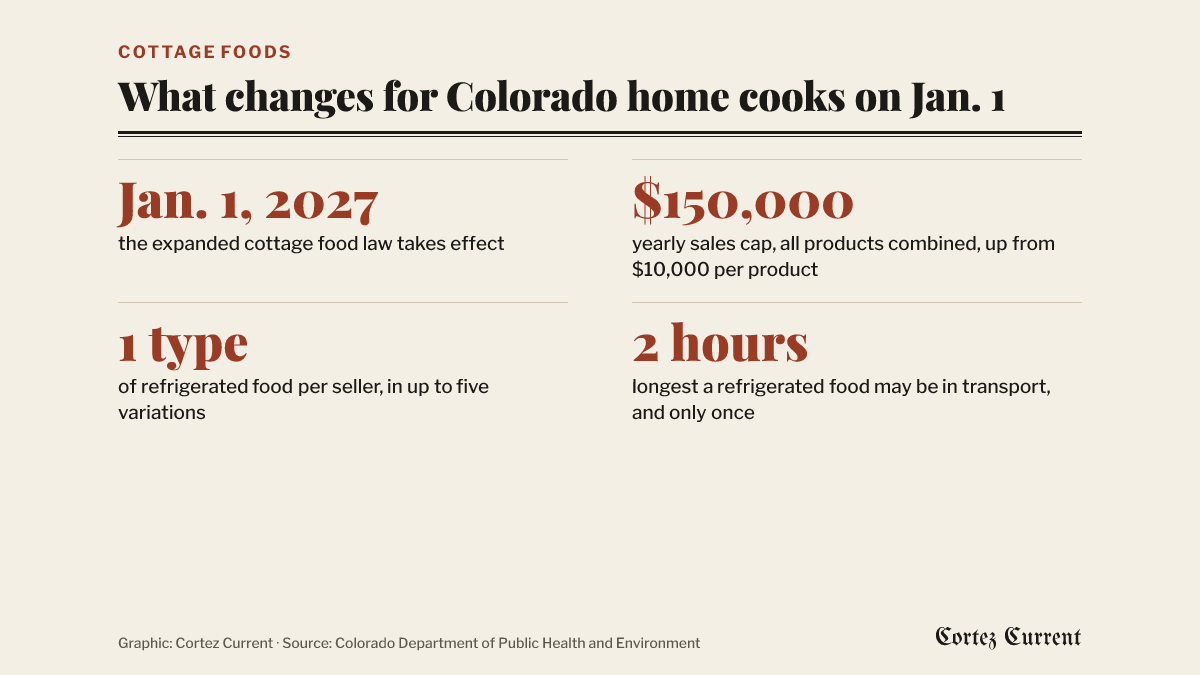 Graphic: Cortez Current. Source: Colorado Department of Public Health and Environment
The state’s expanded Cottage Foods Act, known as the Tamale Act, takes effect Jan. 1, 2027. It lets people sell foods from their home kitchens that need refrigeration, including tamales, burritos and tortas. The Colorado Department of Public Health and Environment’s list of foods approved under the new law includes pies and cobblers, pumpkin among them, along with cheesecakes, cream puffs and eclairs.
The law limits each seller to one kind of food that needs refrigeration, and pie can be that kind. “Under the expanded Cottage Foods Act that takes effect January 1, 2027, home bakers can expand their offerings to include temperature-controlled items like cream pies or pumpkin pies for sale directly to consumers,” the department said in written answers to the Cortez Current. A baker who chooses pie may sell up to five refrigerated varieties, such as chocolate silk, coconut cream and pumpkin, plus any number of pies that are safe at room temperature, the department said.
Under the current law, only foods that are safe without refrigeration may be sold. The department’s current guidance lists baked goods with cream, custard or meringue fillings as ineligible.
That rule is why Checkered Kitchen Co., a home bakery in Lewis, left pumpkin pie off its Thanksgiving menu. In a post on its Facebook page, the bakery told customers that the cottage food law bars home bakers from selling traditional pumpkin pies. The reason, it said, is that they need refrigeration to stay safe and aren’t considered shelf-stable.
“Hopefully, one day the laws will change,” the bakery wrote. Until then, it is offering pumpkin caramel cinnamon rolls and brown butter pumpkin maple cookies instead.
In a second post, the bakery said the state’s update opens “the door for us cottage bakers” to sell more products. It said its 2027 menu would have to wait until Jan. 1.
In an email to the Cortez Current, the bakery said it is “incredibly excited” about the change. Pumpkin pie will be on its Thanksgiving menu in 2027, it said, and it hopes eventually to offer cheesecakes, danishes with sweet custard fillings and other refrigerated treats it can’t sell now.
“There are so many small, home based bakeries across Colorado that have been waiting for opportunities like this,” the bakery wrote.
Shoppers can still buy pumpkin pie from a licensed bakery this year. The Pie Maker Bakery in Cortez will have its traditional pumpkin pie again this Thanksgiving, along with Dutch apple, bourbon pecan and a few specialty items, its owners, Shani Winer and Tim Stubbs, said in an email to the Cortez Current. Orders can be placed through the bakery’s website, by voicemail at 970-560-6039, or in person at pop-up sales at the bakery, 17 N. Harrison St., on Nov. 13 and 14 and Nov. 20 and 21.
Custard pies such as pumpkin and cream pies need proper handling and refrigeration, while some sweet pies, such as apple and cherry, are considered safe at room temperature, the owners wrote. Their licensed commercial kitchen follows health department food handling guidelines, they said.
The owners said they are still learning about the new law. “While we have some concerns about food safety for commercial consumption of time and temperature sensitive products from home kitchens, we have always believed in the ability for different local businesses to complement rather than compete with one another,” they wrote.
House Bill 26-1033 was signed June 4. Its sponsors were Reps. Ryan Gonzalez and Monica Duran and Sens. Robert Rodriguez and Byron Pelton.
What changes Jan. 1
- Refrigerated foods. A seller may offer one type of food that needs time and temperature control for safety, in up to five variations at a time. Five kinds of tamales are allowed; tamales and burritos together are not. Foods that are safe at room temperature remain unlimited. A baker can choose pie as that one type, the department said.
- Meat. Meat must come from a USDA-inspected source, such as a grocery store or butcher, or qualify for an inspection exemption.
- Registration. Sellers must register with the state health department before selling and renew every year. Registration is free and will open before Jan. 1, the department said. A food safety training certificate is required to register.
- Training. Any one of three options meets the requirement: Colorado State University Extension’s cottage food course (certificates last three years), an online food handler’s card, or a course from a local public health agency. For bakers who already hold a CSU certificate, CSU Extension offers an update class on the 2027 rules. It’s free for those who took CSU’s cottage food training from January through August 2026 and $10 for other certificate holders, the department said; the department’s other training options also count.
- Sales cap. The limit rises from $10,000 a year for each product to $150,000 a year in total gross sales. The state will adjust it for inflation each year.
- Labels. Each package must carry the producer’s name and registration number, the county where the food was made, a phone number or email address, the date it was made, a full ingredient list, a home-kitchen disclaimer and the department’s cottage food web address.
- Transport. Refrigerated foods must stay at a safe temperature, can be transported only once and for no more than two hours, and can’t be cooled and reheated before sale.
Some things stay off the menu: raw milk, anything over 5% alcohol by volume, anything containing THC or CBD, pet food, home pressure-canned and other low-acid canned foods, vacuum-packed foods, and foods cured or smoked for preservation.
Cottage foods may be sold only in Colorado, directly to the customer, in person or online. They can’t be sold to restaurants or stores for resale. A seller whose product is misbranded or draws a consumer complaint of food-borne illness can be fined up to $100 and charged up to $1,000 to cover the state’s investigation costs. Three violations within 12 months end a seller’s right to sell refrigerated foods under the law.
Based on registration numbers in other states, the department expects thousands of home producers to register.
The department’s cottage foods program can be reached at cdphe_cf@state.co.us. Its 2027 Tamale Act page lists 303-692-2843; its current cottage foods page lists 303-692-3645, option 1.