County buildings are aging and hard to reach, consultants tell board
A facilities study found services spread across buildings from 1938, 1960 and the 1990s, with an elevator the public can only reach by walking through other departments. Commissioners asked for prices on the small fixes first.
Montezuma County’s buildings were not built for the way the county works now, consultants told commissioners at Monday’s workshop — and with the budget where it is, the board asked them to price the cheapest fixes first.
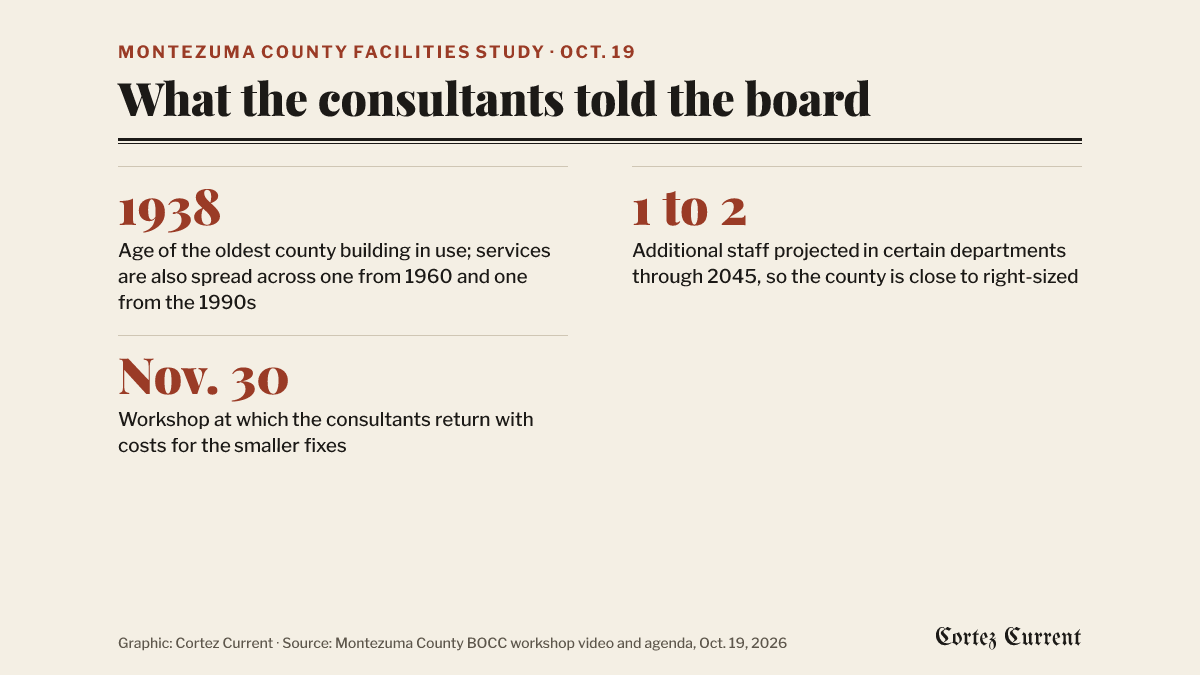 Graphic: Cortez Current. Source: Montezuma County BOCC workshop video and agenda, October 19, 2026
No votes were taken. A county workshop is a discussion, and what came out of this one was direction to the consultants rather than a decision.
What the study found
Kate Sawyer of Performance Services, the firm the county hired for a facilities assessment, told the board her team met every department, reviewed the county’s own data and set it against state population projections. The firm’s architect and senior designer took the board through the findings.
County services are spread across several locations, the architect said, which makes them hard for the public to find. The buildings themselves were put up at different times — the oldest dating to 1938, another to 1960 and another to the 1990s — and none was built for modern services or for accessibility law. Buildings with solid bones can still reach the point where keeping old systems running costs more than a modern building would.
The clearest example came up twice. The elevator serving the public sits at the back of the building, and people who need it have to be walked through several departments to reach it. The older half of the building is served by a stair lift. “How do you get ADA people up a set of stairs to get to the elevator?” one commissioner asked. The architect also noted that a visitor’s route and a staff route run together in places, which he said raises liability and risk.
He added one structural oddity: the district attorney’s office sits with county services rather than beside the combined courts building the county built recently. Most counties keep the two together, he said, and a small addition at the courts building could improve both efficiency and security.
On growth, the firm’s finding was that the county is close to right-sized. It projects perhaps one or two additional staff in certain departments through 2045, with the district attorney’s office and social services depending heavily on state funding decisions the county does not control.
Three paths, no prices yet
The consultants laid out three directions rather than recommendations: a new consolidated building on a larger site, built in phases, which could free up property the county now occupies in revenue-producing areas; a smaller project moving the district attorney to the combined courts building; or buying and reusing an existing building that already has the structure, access, security and floor area the county needs.
No cost analysis has been done. Sawyer said the firm deliberately held off pricing options until it knew which ones the county considered feasible. “It’s a little bit of a chicken before the egg thing here,” she said.
Commissioners answered with the budget. The county is already drawing millions from reserves to balance its 2027 budget, and one commissioner said the outlook does not improve, pointing to falling production at Kinder Morgan with no new wells going in and company projections that run only to about 2030. “As far as new facilities goes, it doesn’t look very promising,” he said.
Sawyer said she talks to few counties anywhere that can afford to replace their facilities, let alone do major renovations, and suggested a phased approach that deals with the most urgent items first, noting construction costs are not falling.
What the board asked for: prices on the smaller items — relocating the district attorney, and fixing the flow of the existing building for accessibility and security — rather than on a new building. The consultants will also bring a table of comparable costs, so the county can show the public what a new county administrative building of a given size costs elsewhere in Colorado. The firm said its estimating team needs four or five weeks, and the board set the next presentation for the workshop on Monday, November 30 at 1:30 p.m.
Sheriff’s office short nine positions
Separately, the sheriff’s office asked the board to back a new hiring plan, and the commissioners approved it on the consent agenda at Tuesday’s meeting.
Undersheriff Tyson Cox told the workshop the office is five short in its detention division and four short in operations, and that hiring has become the harder half of the problem: of the last six applications to the detention division, only one person could be hired, because of criminal history and other issues.
The plan has two parts. New hires would get a sign-on bonus — $2,500 in patrol, $1,500 in detentions — paid in halves, the first on completing field training and the second at the end of the year-long probation. And experienced officers would get credit for it: five years as a certified deputy would move a new hire up one step on the pay scale, to a maximum of three steps, so someone arriving with 15 years would start at deputy-three pay rather than deputy-one.
Cox said the plan asks for no new money. Because the office is running short, salary money budgeted for unfilled posts would pay for the bonuses. From 2027, he said, Proposition 130 money could also be used.
He described the problem it is meant to fix as losing experienced people to Cortez police, to Mancos and to the Colorado Bureau of Investigation. The county’s usual route — hiring detention officers and sending them to the academy after a couple of years, at about $13,000 each — gives detention staff a career path and vets them for two years, he said, but cannot backfill patrol fast enough. The sign-on plan still has to be written into a memorandum of understanding with the Fraternal Order of Police, with whom the county is in open negotiations; board approval was the first step.
Commissioners were supportive without committing money beyond what the proposal uses. “I’m not against you trying to get people to stay here, because that experience is hard to come by,” one said.
Department updates
- Buildings and grounds. Dustin Sattler said sprinklers have been blown out for the winter, kitchen hoods have had their six-month inspection, the annual fire suppression inspection and backflow test are done, and the janitorial walkthrough was last week with bids due Monday, October 26.
- Vehicle maintenance. Cole Uptain said every snow plow has been checked and is ready, fleet maintenance is on schedule, and the Road and Bridge auction list has been submitted and is waiting on a date for photographs and listing.
- Information technology. Jim McClain said the courthouse camera project is moving quickly, with about 10 cameras in. He has spent the past week working out how the shared city-county IT arrangement will run, and expects shared services, some cost savings and cross-training on both sides. “It’s a lot, but I think we can get it under control,” he said.
- Natural resources and noxious weeds. James Dietrich reported on the trail project between Mancos and Mesa Verde. Survey results for two segments on the Mancos side were expected within days; permitting with the Bureau of Land Management and the National Park Service should be finished around December or the start of the year; about 500 feet of Lumen line will need lowering, with responsibility for the work still unsettled; and another segment is waiting on environmental documents before right-of-way acquisition can begin. A federal grant application went in during August.
The workshop is posted on the county’s YouTube channel and the agenda is on the county’s news page. Commissioners hold a workshop most Mondays at 109 W. Main St., Cortez.