Cortez council adopts water master plan, raises spending limits
The plan puts the city's 40-year-old raw water line and dam at the top of a 20-year repair list that costs far more than Cortez now budgets. The council also updated purchasing limits last set in 2001.

The Cortez City Council on Tuesday adopted the city’s 2026 Water System Master Plan as a guide for the next two decades of water spending, after hearing that the system works well today but needs far more investment than the city has been making. The vote was 7-0. The council had the plan on its agenda for this meeting, as previewed Monday.
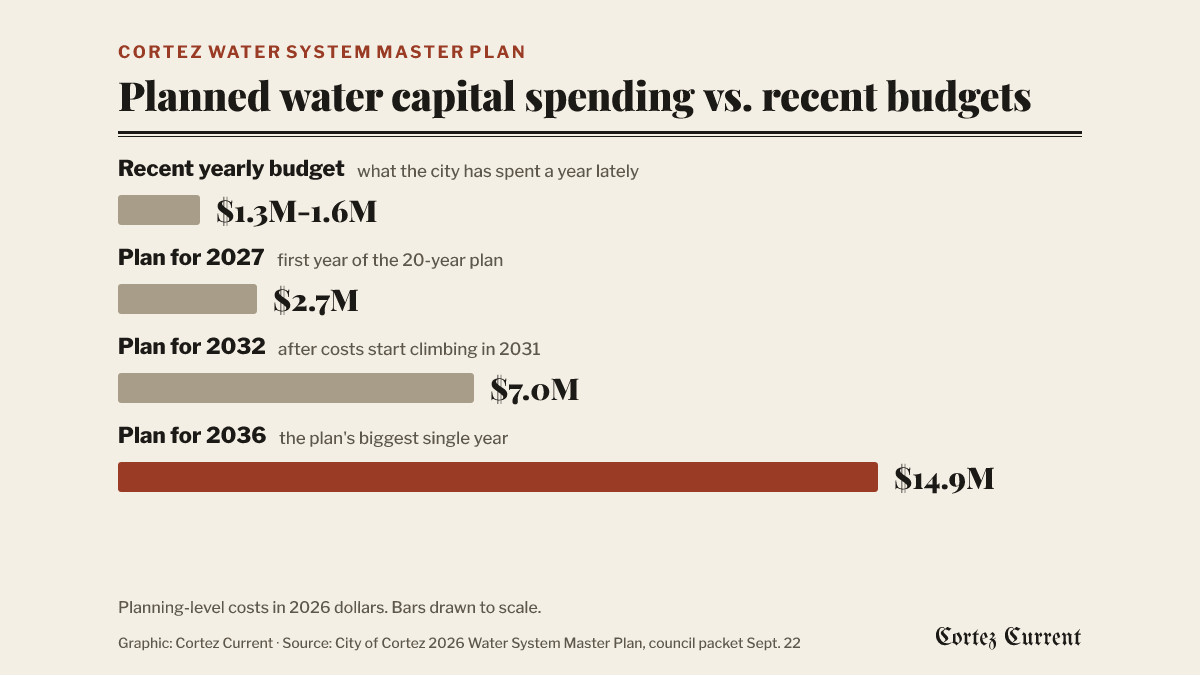 Graphic: Cortez Current. Source: City of Cortez 2026 Water System Master Plan
What the plan says
Casey Simpson, the city’s director of public works and general services, presented the plan, prepared by the engineering firm Schmueser Gordon Meyer. The system serves about 3,784 metered customers, bulk water users and two outside systems, Montezuma County Water District No. 1 and the Ute Mountain Ute Tribe, through a raw water line, the water treatment plant and more than 71 miles of distribution pipe.
The plan’s highest priority is the raw water supply. The line that brings raw water to the treatment plant, about 21,000 feet of pipe, was installed in 1986 and has not been inspected since. An inspection is scheduled for 2027 at a cost the city’s council memo puts at about $750,000. Simpson told the council the reservoir’s historic outlet valve no longer works, and the plan calls for new outlet control gates and other dam safety work. The estimated cost of a second, backup raw water line rose from more than $15 million in an earlier draft to about $24 million.
The city’s firm water supply is about 2,300 acre-feet a year. The plan projects demand will pass that around 2059, sooner with drought, faster growth or new uses such as parks and golf. Simpson said the city has begun talks with the Dolores Water Conservancy District about acquiring more water.
At the treatment plant, pretreatment is the bottleneck. Simpson said the plant reached that limit about two weeks ago, during a water line leak in the Carpenter area while the golf course was also drawing water. He told the council the leaking transmission pipe runs through a drainage and was “paper thin” in spots, breaking in two places.
In the distribution system, the plan identifies roughly 10,900 feet of pipe in the worst condition. The city’s own crew, now in its first full year of installing water line, can replace about 5,000 feet a year, a pace Simpson said would take more than 100 years to renew all of the mains, which last about 50. He said the department hopes first to add a paving crew to patch streets behind the pipe work, and called adding staff and equipment a three- to five-year effort. Cherry, Maple and Linden streets and some transmission line work are planned for next year.
The cost
Over the past five years the city has budgeted $1.3 million to $1.6 million a year for water capital projects. The plan’s 20-year schedule calls for $2.7 million in 2027, rising sharply from 2031, with $7.0 million in 2032 and $14.9 million in 2036. It recommends a combination of water rate adjustments and outside money such as grants and low-interest loans. “We’re not going to be able to afford all of this internally,” Simpson said.
The plan concludes the city is not facing an immediate water infrastructure crisis. One council member questioned that conclusion, pointing to the recent line break. Simpson said the work is urgent in public works terms, since projects that take 15 years need to start now, but that residents should not expect their taps to run dry tomorrow.
Spending limits
The council also raised the dollar limits on who can approve city purchases, which had not changed since 2001 (Resolution No. 14, Series 2026, 7-0). Under the new benchmarks:
- The purchasing agent may buy items costing $1,000 or less.
- Purchases of $1,000 to $10,000 need two formal quotes and a department director’s approval; purchase orders are required above $5,000.
- Purchases of $10,000 to $50,000 need three formal quotes and the city manager’s approval.
- Anything over $50,000 goes out for formal bids or proposals and needs council approval.
Simpson told the council the new limits sit at the low end of the state’s recommended practices, and staff reported no fiscal impact.
Other business
All other items also passed 7-0.
- Gopher store: the council, sitting as the local liquor licensing authority, approved a new beer and wine license for UPOP Holdings LLC, doing business as Gopher Store #49, at 2410 Fairway Drive. A petition survey gathered 74 signatures in favor and none against; Police Chief Vernon Knuckles reported six neighbors in favor and one against, and no known public safety issues.
- The Junction: because the building at 309 North Broadway sits partly in the city and partly in the county, the council approved an intergovernmental agreement with Montezuma County that lets the city license and regulate the whole property. The county commissioners signed it that morning. The council then set a public hearing for Oct. 13 on a new tavern liquor license for Junction Enterprises LLC, doing business as The Junction, at that address.
- Historic designations: the Garland Home at 120 East North Street, built in 1942, was added to the city’s register of historic resources on second reading. The building at 209 West Main Street passed on first reading, with its second reading and hearing set for Oct. 13.
- Carport: a conditional use permit and minor setback deviation for a partly built carport at 1411 Montelores Ave. Construction stopped when code enforcement contacted the owners, who then applied for the permits. The carport must stay open on the sides.
- Consent agenda: a Business After Hours permit for the Cortez Area Chamber of Commerce on Oct. 8, and hotel and restaurant liquor licenses for Loungin’ Lizard at 2 West Main Street and Mi Mexico at 801 East Main Street.
In council reports, the golf advisory committee said the course has logged 22,584 rounds this year, about 1,800 more than at the same point in 2025, with revenue of $643,000, up $71,300. Council member Claire West said the parks and recreation master plan anticipates more than $23 million in capital needs over 10 years and urged residents to attend its listening sessions.
The council’s next regular meeting is Oct. 13. The meeting is on the city’s YouTube channel, and the agenda packet includes the full water plan and Resolution No. 14.